


Turn Heartbreak into Carats: JCPenney’s Bold “Ex-Change” for Singles This Valentine’s Day
Valentine’s Day is traditionally marketed as a celebration of coupled bliss—a day of roses, chocolates, and grand romantic gestures. But for millions of singles, or those recently emerging from a relationship, the holiday can serve as a stark reminder of past flames that have since burned out. This year, retail giant JCPenney is flipping the script on the season of love with a daring, headline-grabbing campaign designed specifically for the unattached.
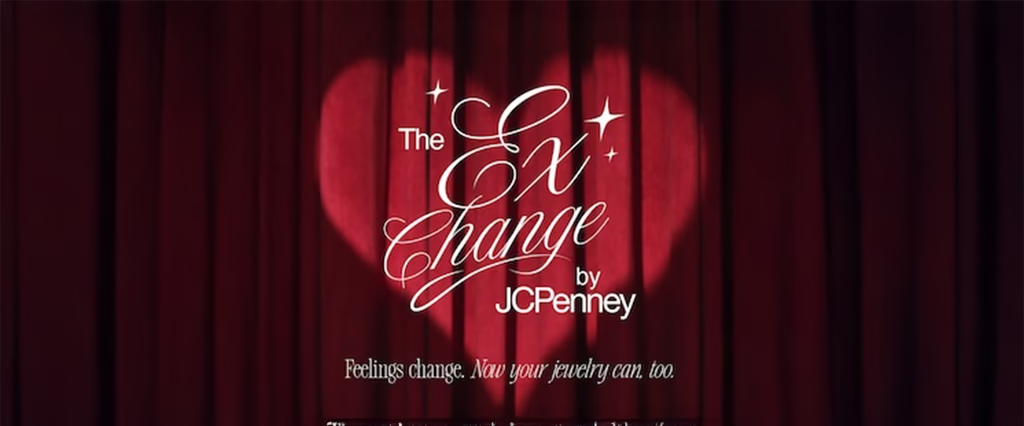
In a move that blends retail therapy with emotional closure, JCPenney has announced “The JCPenney Ex-Change.” This innovative event invites customers to raid their jewelry boxes for pieces that carry the heavy weight of bad memories and trade them in for something sparkling, new, and entirely their own.
The “Ex-Change”: How to Trade Your Past for a Diamond
The concept is simple yet brilliantly cathartic: if you are holding onto a ring, necklace, or bracelet given to you by an ex—or perhaps a piece you bought for yourself during a time you’d rather forget—JCPenney wants to take it off your hands. In return, they are offering a fresh start in the form of a stunning piece of fine jewelry.
Qualifying participants who bring in a used item of jewelry will receive a half-carat lab-grown diamond necklace. This isn’t a trinket; it is a substantial piece of fine jewelry set in 14k gold over silver, with a comparable retail value of approximately $375.
A “No Questions Asked” Policy for Maximum Comfort
One of the most attractive aspects of this promotion is the frictionless nature of the exchange. JCPenney has explicitly stated that the event will operate under a “no appraisals, no fees, no questions” policy.
Jillian Roig, the Vice President and Divisional Merchandise Manager of Fine Jewelry at JCPenney, emphasized that the retailer understands the vulnerability associated with these items. Customers do not need to explain why the item is being traded in, nor do they need to worry about the monetary value of the piece they are surrendering. Whether it’s a cheap silver band from a high school fling or a more significant piece from a long-term partner, the exchange rate is the same.
“Everyone is offered the same necklace,” Roig explains. “The goal is to help customers move on from that piece and create something new in their lives.”
Where and When to Upgrade Your Jewelry Box
This exclusive event is set to take place on Valentine’s Day (February 14), turning a typically dreaded Saturday for singles into a potential treasure hunt. However, due to the high value of the exchange item, availability is strictly limited, creating a buzz of exclusivity.
- The Flagship Event: The primary location for the Ex-Change is the JCPenney store in Garden City, New York. Here, the first 100 customers to arrive with their trade-in item will receive the diamond necklace.
- Nationwide Availability: Recognizing that heartbreak isn’t limited to Long Island, JCPenney is extending the offer to 10 other select locations across the United States. At these additional stores, the first 50 customers in line will be able to participate in the swap.
For those planning to attend, the advice is clear: arrive early. With the rising popularity of lab-grown diamonds and the high retail value of the gift, lines are expected to form well before store openings.
Redefining Valentine’s Day: Inclusivity in Retail
The “Ex-Change” campaign represents a significant shift in how major retailers approach the mid-February holiday. Historically, department stores have poured their marketing budgets into imagery of happy couples, engagement rings, and gifts for spouses. By targeting singles, JCPenney is tapping into a massive, often underserved demographic.
Celebrating the “Anti-Valentine’s” Sentiment
“Most retailers focus on couples and the classic Valentine’s Day romance,” notes Roig. “At JCPenney we are too—but there are people who are excluded from that holiday, and we love to be inclusive. So whether they’re single, post-breakup, or entering a new chapter, we thought this is something great for them.”
This strategy aligns with a broader cultural trend known as “Galentine’s Day” or “Anti-Valentine’s Day,” where self-love and platonic friendships are celebrated over romantic entanglements. By acknowledging that not everyone is in a relationship—and that many are actively healing from one—JCPenney builds emotional rapport with its customers. The promotion acknowledges a universal truth: letting go of the past is hard, but it’s a lot easier when there is a diamond waiting on the other side.
Giving Back: The Ethical Angle
Crucially, the jewelry collected during this event isn’t just being discarded or melted down for scrap immediately. Reports on the campaign indicate that JCPenney plans to donate the surrendered items to Good360, a global nonprofit leader in product philanthropy. This ensures that while the previous owners are shedding the emotional baggage attached to the items, the physical pieces will eventually find a way to do good, adding a layer of ethical satisfaction to the exchange.
The Rise of Lab-Grown Diamonds at JCPenney
Beyond the immediate excitement of the Valentine’s Day stunt, this promotion serves as a strategic spotlight on JCPenney’s significant investment in the lab-grown diamond market. The necklace being given away is not just a freebie; it is a brand ambassador for one of the retailer’s most important growth categories.
Democratizing Luxury for the Modern Shopper
JCPenney has positioned itself as a pioneer in bringing lab-grown diamonds to the mass market. These stones, which are chemically, physically, and optically identical to mined diamonds, are created in controlled environments using advanced technological processes.
“We were industry leaders in bringing in lab-grown when it first came on the market,” says Roig. “I think that’s given us a competitive advantage.”
For the average consumer, the primary appeal of lab-grown diamonds is the price. As production technology has improved, the cost of creating these diamonds has plummeted, allowing retailers to pass those savings on to the shopper. Roig describes this as “democratizing luxury.”
“A large portion of our assortment has transitioned to lab-grown,” she states. “We have not seen any customer resistance to it. It allows us to carry that full breadth of assortment and design aesthetic, as accessible luxury. I think that is a winning combination for JCPenney.”
The Shift to “Bigger is Better”
One of the most interesting trends Roig highlights is how the affordability of lab-grown stones has shifted consumer preferences regarding size. In the past, a budget-conscious shopper might have been limited to a quarter-carat or half-carat mined diamond. Today, that same budget can purchase a stone that is significantly larger and of higher clarity.
“It makes them more affordable for our customer base,” Roig adds. “I think customers are seeing the opportunity to get pieces they only ever dreamed of, in lab-grown.”
Data from JCPenney’s sales floor backs this up. Roig notes that shoppers are now gravitating toward lab-grown diamonds that are 2 carats and up—sizes that would be prohibitively expensive for most people if they were natural, mined stones. By offering a half-carat necklace in the Ex-Change, JCPenney is essentially providing a “starter piece” that introduces customers to the quality and brilliance of lab-grown jewelry, likely enticing them to return for those larger, statement pieces later.
Why This Campaign Works
From a marketing perspective, the JCPenney Ex-Change is a masterclass in behavioral economics and emotional branding.
- The Endowment Effect: People often value items they own more than they are worth. However, by framing the old jewelry as “burdened” with bad memories, JCPenney lowers the perceived value of the customer’s current item, making the trade for a “clean slate” diamond feel like an incredible bargain.
- Scarcity and Urgency: By limiting the offer to the first 50 or 100 people, the retailer guarantees foot traffic and creates a media-friendly spectacle of lines wrapping around the block.
- Viral Potential: The premise is inherently shareable. It’s the kind of story friends tag each other in on social media (“Hey, get rid of that ring from Steve and let’s go to the mall!”).
Conclusion: A Sparking New Chapter
This Valentine’s Day, JCPenney is proving that they understand their customer base goes beyond just happy couples shopping for engagement rings. By offering a tangible way to trade a painful past for a sparkling future, they are engaging with the emotional reality of their shoppers’ lives.
For the lucky few who manage to snag one of the half-carat necklaces at the Garden City store or the participating nationwide locations, the 14th of February won’t be about what they lost. It will be about what they gained: a beautiful piece of jewelry, a story to tell, and the undeniable satisfaction of an upgrade.
If you have a piece of jewelry sitting in the back of your drawer, collecting dust and bad vibes, this might be the sign you’ve been waiting for. Dust it off, head to JCPenney, and prepare to ex-change your heartbreak for a diamond that belongs only to you.