


A Diamond in the Rough: How a $115 Million Federal Lifeline Rescued the Ekati Mine from the Brink
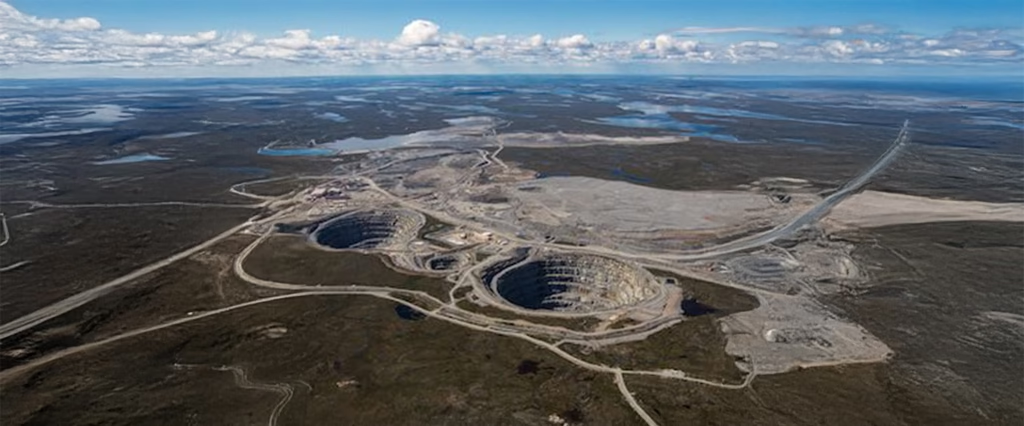
For nearly three decades, the Ekati Diamond Mine has stood as a glittering symbol of Canada’s northern industrial prowess. Located in the remote Lac de Gras region of the Northwest Territories, roughly 300 kilometers northeast of Yellowknife, it was the first surface and underground diamond mine in the country. However, in late 2025, the sparkle of this Arctic gem nearly faded forever. Faced with a “perfect storm” of collapsing global prices, aggressive international trade wars, and the rising tide of lab-grown alternatives, the mine’s owner, Burgundy Diamond Mines, found itself staring down the barrel of bankruptcy.
In a dramatic turn of events, the Canadian federal government stepped in with a massive financial intervention. A CAD $115 million (approximately USD $83 million) loan has been granted to keep the lights on, the wheels turning, and the workers employed. This rescue package is more than just a corporate bailout; it is a calculated bet on the economic survival of the Northwest Territories and a defensive maneuver in a volatile global trade landscape.
The Eleventh Hour: A “Bleak and Stark” Path to Bankruptcy
The severity of the crisis at Ekati cannot be overstated. Jeremy King, the CEO of Australia-based Burgundy Diamond Mines, recently pulled back the curtain on the company’s internal struggles. In a candid interview with the CBC, King admitted that the mine was “weeks away” from a total shutdown. The scenario he described was one of existential dread for the company and its workforce.
“We were in a very bleak, or stark, scenario,” King noted. “It was either this line or we were looking at bankruptcy and shutting the mine down.” For a project that provides nearly 20% of the Northwest Territories’ Gross Domestic Product (GDP), the prospect of a sudden closure was a nightmare scenario for regional policymakers. The mine isn’t just an extraction site; it is a community anchor that sustains hundreds of families and dozens of local businesses.
While the $115 million loan provides a temporary bridge, King was quick to temper expectations. He warned that the funding is “not a fix-all” and that the industry continues to navigate “a very challenging time.” The loan is designed to provide the liquidity necessary to weather the current market downturn, but the underlying structural issues of the global diamond trade remain.
Understanding the Large Enterprise Tariff Loan (LETL) Facility
The financial lifeline did not come from a traditional commercial bank, many of which have become increasingly wary of the volatile diamond sector. Instead, the funding was facilitated through the Large Enterprise Tariff Loan (LETL) facility. This program is managed by the Canada Enterprise Emergency Funding Corporation (CEEFC), a subsidiary of the Canada Development Investment Corporation (CDEV).
The LETL was specifically established to support large Canadian enterprises that have been disproportionately impacted by international trade disruptions and tariffs. To qualify, companies must demonstrate a significant impact on the Canadian economy, maintain a substantial workforce, and meet specific revenue thresholds.
The Technical Details of the Rescue Package
The loan agreement is structured to protect Canadian taxpayers while providing the mine with the breathing room it needs to restructure:
- Total Amount: CAD $115 million, to be received in installments.
- Structure: The loan is split into two facilities. Roughly 75% is an unsecured facility with a seven-year term, while the remaining 25% is secured against the company’s assets.
- Interest Rates: The loan carries a rate of the three-month Canadian Overnight Repo Rate Average (CORRA) plus 200 basis points for the first two years, with the margin increasing in subsequent years to encourage early repayment.
- Government Equity: As part of the deal, Burgundy Diamond Mines has agreed to issue over 1.1 billion unlisted warrants to the CEEFC. If exercised, these would represent approximately 43% of the company’s issued share capital, effectively giving the Canadian government a significant potential stake in the mine’s future upside.
The “Tariff Trap”: Why Global Trade Wars Hit the Arctic
One might wonder how a diamond mine in the subarctic can be brought to its knees by trade policy in Washington or New Delhi. The answer lies in the highly interconnected nature of the “diamond pipeline.”
Rough diamonds mined at Ekati are not sold directly to consumers. Instead, they are sold to wholesalers and manufacturers, primarily in India. In fact, approximately 90% of the world’s rough diamonds are cut and polished in India. Under the current global trade climate, the U.S. government—the world’s largest market for finished jewelry—has imposed a staggering 50% tariff on diamond imports from India.
This tariff has created a massive bottleneck. Indian manufacturers, faced with a 50% levy to access their primary customer base in America, have drastically reduced their purchases of rough diamonds. This lack of demand has caused global prices for rough stones to plummet. For Ekati, which already faces high operational costs due to its remote location and the complexities of Arctic logistics, this price collapse was the final blow to its profit margins.
Furthermore, additional “reciprocal” tariffs between Canada and the United States have added layers of cost to the machinery, fuel, and supplies required to keep the mine running. The LETL loan is specifically intended to “bridge” this period of trade-induced volatility, allowing the company to wait for a potential stabilization of trade relations or a realignment of the global supply chain.
A Pillar of the Northern Economy: Protecting Jobs and Indigenous Partnerships
The decision by the federal government to intervene was driven by more than just trade logic. It was a social and regional necessity. Ekati is one of the largest private-sector employers in the Northwest Territories. The mine directly employs more than 600 workers, with hundreds more employed through contractors and service providers.
Crucially, the mine is a vital source of income for Indigenous communities. In 2024 alone, Ekati employed over 200 Northern Indigenous workers and invested approximately $210 million into Northern Indigenous-owned businesses. A sudden closure would have wiped out decades of progress in Indigenous economic development.
Caitlin Cleveland, the NWT Minister for Education, Culture, and Employment, expressed the collective sigh of relief felt across the North. “Our priority continues to be people,” she stated. “The diamond industry has long strengthened communities, supported local businesses, and created opportunities across the North.”
Conditions for the Survival
The government has not handed over the $115 million without strings attached. The “strong conditions” mentioned by federal spokespeople include:
- Job Guarantees: Burgundy must maintain specific employment levels to ensure the local economy is protected.
- Repayment Priority: The loan ranks senior to almost all other existing debt, ensuring the government is first in line for repayment.
- Restructuring Requirements: The company must successfully restructure its balance sheet, including subordinating existing senior debt and negotiating discounts with trade creditors.
The Strategy for the Future: Pivoting to High-Value Deposits
Simply having cash in the bank is not enough to save Ekati in the long run. Burgundy Diamond Mines is using this opportunity to pivot its operational strategy. The company has moved the processing plant to a “two-weeks-on, two-weeks-off” campaign basis to save on labor and energy costs.
More importantly, the company is shifting its focus away from lower-quality yields and toward the highest-value products within the Ekati complex. This includes the reactivation of the Sable open pit and development work on the Fox underground deposit. The Fox deposit, in particular, represents the “next chapter” for Ekati, with a projected mine life of over 12 years and a high concentration of gem-quality diamonds that remain profitable even in a depressed market.
Conclusion: A Precarious but Hopeful Outlook
The $115 million loan from the Canadian government has successfully staved off a catastrophic closure, but the road ahead for the Ekati Diamond Mine remains steep. The industry is still grappling with the long-term threat of lab-grown diamonds and the persistent uncertainty of international trade relations.
However, for the hundreds of workers in the Northwest Territories and the Indigenous businesses that rely on the mine, this federal intervention is a lifeline that offers hope. It preserves a vital piece of Canada’s northern infrastructure and keeps the country’s diamond legacy alive. As Jeremy King and his team at Burgundy work to lower costs and tap into higher-value ore, the world will be watching to see if this pioneer of the North can truly reclaim its sparkle in a changed global economy.