


The Unwanted Savior: Why Signet Rejects Gerald Ratner’s Audacious Bid for UK Stores
The ghost of the British high street’s most infamous gaffe has returned, as retail titan Signet Jewelers firmly rejects a hostile overture from its former owner, Gerald Ratner.
In a saga that blends corporate strategy with deep-seated personal history, Signet Jewelers has made its position crystal clear regarding the unsolicited interest from Gerald Ratner. The former jewelry tycoon, who infamously imploded his own empire in 1991 with a single self-deprecating joke, is attempting to buy back the company’s UK division. However, the current American leadership of Signet seems to view his bid with the same disdain Ratner once reserved for his own products: to borrow his phrasing, they likely think it is “total crap,” although corporate PR constraints prevent them from using such colorful language.
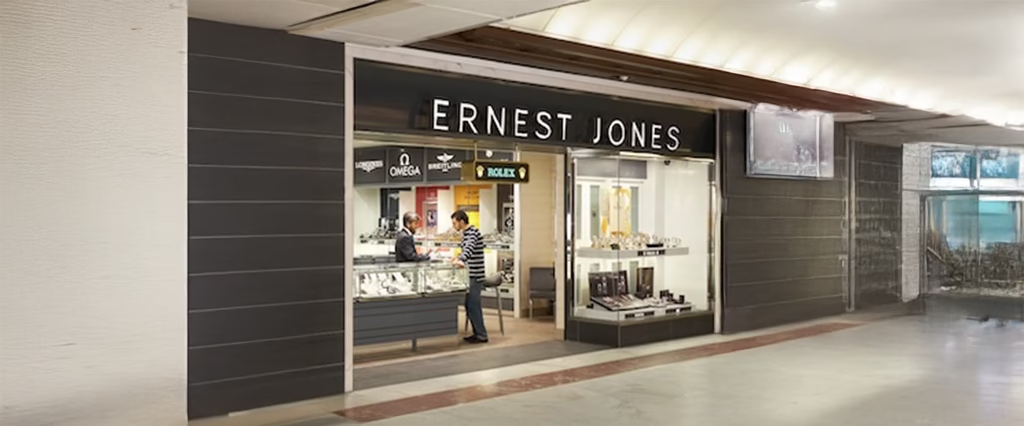
Despite a flurry of media attention and two high-profile articles in the British press this week touting Ratner’s “audacious bid,” the retail giant has reiterated that its heritage UK brands—H. Samuel and Ernest Jones—are categorically not for sale.
A Hostile Overture from the Past
The conflict began to simmer earlier this year but boiled over recently when Ratner spoke to the Times of London, outlining his aggressive strategy to reclaim the business he lost three decades ago. Ratner, now a veteran businessman who has spent years rebuilding his reputation, is not merely asking for a meeting; he is threatening to bypass the board entirely.
According to the Times, Ratner plans to appeal directly to Signet’s shareholders, urging them to revolt against the current management. His pitch is simple yet aggressive: the American owners are mishandling the British assets, and he has the capital ready to take the problem off their hands.
“We have all the money lined up so we’re not going to mess them about,” Ratner was quoted as saying, projecting a tone of serious financial intent. “We are trying to put pressure on shareholders, because it’s in their best interests to dump the U.K. It’s a bit of a long, drawn-out negotiation that hasn’t reached fruition yet.”
Ratner’s rhetoric attacks the very competence of Signet’s current leadership. He portrays the UK division as a neglected stepchild of a US-centric conglomerate, arguing that the shareholders would be better off liquidating the British arm of the business rather than letting it wither under foreign management.
Signet’s Firm Rebuttal: A Corporate “No”
In response to the media storm, Signet Jewelers issued a statement to JCK today, maintaining a cool, corporate distance from Ratner’s emotional offensive. The company refused to engage in a public war of words but left no ambiguity regarding the status of its stores.
“While it is not our policy to comment on rumors or speculation, we are not engaged in discussions related to a sale of our U.K. brands,” the statement read.
This dismissal echoes a similar statement issued earlier in the year when rumors of Ratner’s interest first surfaced. For Signet, the UK division—comprising hundreds of H. Samuel and Ernest Jones storefronts—remains a core component of their portfolio, despite the challenging retail environment. The refusal to even entertain “discussions” suggests that Signet views Ratner’s bid not as a financial opportunity, but as a distraction from a figure who has been exiled from the corporate boardroom for over thirty years.
The “Ratner Effect”: The £500 Million Joke
To understand the friction between Gerald Ratner and the company now known as Signet, one must look back to April 23, 1991. It remains one of the most cautionary tales in the history of global business, often taught in business schools as the “Ratner Effect.”
At the time, the Ratners Group was a high-street powerhouse. Gerald Ratner had built the family business into a dominator of the market, democratizing jewelry with affordable prices and aggressive marketing. However, during a speech at the Institute of Directors at the Royal Albert Hall, he made a fatal error in judgment.
Attempting to be self-deprecating and humorous, Ratner described a sherry decanter his company sold for £4.95. He asked the audience, “How can you sell this for such a low price?” His punchline: “Because it’s total crap.”
He didn’t stop there. He went on to mock a pair of earrings sold for under a pound, joking that they were “cheaper than a prawn sandwich from Marks & Spencer, but I have to say the sandwich will probably last longer than the earrings.”
The fallout was immediate and catastrophic. The British public, feeling insulted by the man who sold them their engagement rings and anniversary gifts, boycotted the stores. The value of the Ratners Group plummeted by an estimated £500 million virtually overnight. In 1992, Gerald Ratner was ousted from the company he built.
In an effort to distance itself from the toxicity of the brand name, the Ratners Group was rebranded as Signet Jewelers. The Ratners storefronts were converted into H. Samuel locations, burying the founder’s name along with his reputation. Now, three decades later, the man who nearly destroyed the company is arguing he is the only one who can save it.
The “American Formula” vs. British Heritage
The core of Ratner’s argument for the buyout rests on a cultural and operational clash. He claims that Signet, which is now domiciled in Bermuda and headquartered in Akron, Ohio, does not understand the nuances of the British high street.
“It’s a typical situation of Americans running a U.K. division that they’re not interested in,” Ratner told the press. His critique focuses on the “cookie-cutter” approach often applied by multinational corporations. “They are trying to indoctrinate a U.S. formula in the U.K., and that never works. They’ve so underperformed in the U.K., it’s absolutely diabolical.”
Ratner’s assessment paints a grim picture of the current customer experience. “It’s difficult to see precisely what their figures are, but you can just see their shops are completely empty,” he claimed. “Every day, one is closing. So we thought we’d catch it before they close them all.”
There is some market context to support Ratner’s skepticism, if not his hyperbole. The UK high street has suffered immensely in the last decade, with heritage brands struggling against rising rents, business rates, and the shift to online shopping. Ratner argues that H. Samuel and Ernest Jones are heritage brands that require a specific, localized touch—something he believes a distant American board cannot provide.
The Value of H. Samuel and Ernest Jones
Despite the struggles of physical retail, the brands Ratner targets possess immense historical value:
- H. Samuel: Dating back to 1862, this brand is deeply ingrained in the British consciousness as the go-to mass-market jeweler.
- Ernest Jones: Founded in 1949, it occupies the mid-market space, focusing on diamonds and watches.
Ratner maintains that these are “still very good brands” that are simply being mismanaged. His strategy implies a return to the basics of British shopkeeping—likely aggressive pricing and localized marketing—removed from the bureaucratic oversight of a US conglomerate.
A Standoff with History
The irony of the situation is palpable. Gerald Ratner, who lost his empire because he jokingly called his products “crap,” is now accusing the new owners of treating the stores like “crap.”
For Signet, the rejection is likely about more than just money. Handing the keys back to Gerald Ratner would be a symbolic admission of defeat, undoing thirty years of corporate restructuring designed specifically to erase his legacy. Furthermore, while Ratner claims the stores are “empty,” Signet’s financial reports generally present a more stable, albeit challenging, picture of their UK operations.
Ratner, however, remains undeterred. “Everything that goes around, comes around,” he has said in the past regarding his business philosophy. With investors lined up and a direct appeal to shareholders in motion, he is banking on the idea that money talks louder than historical gaffes.
For now, the doors to H. Samuel and Ernest Jones remain firmly under Signet’s control. But as Ratner continues to apply pressure through the press and shareholders, the retail world is watching closely. Will the man who famously destroyed a jewelry empire be given the chance to polish it back to brilliance, or will Signet continue to keep the “King of Bling” in exile?
Key Takeaways:
- The Bid: Gerald Ratner is attempting a hostile buyback of Signet’s UK division (H. Samuel and Ernest Jones).
- The Rejection: Signet Jewelers denies any discussions, stating the brands are not for sale.
- The Criticism: Ratner claims US management is “diabolical” and failing to understand the UK market.
- The History: The conflict is rooted in Ratner’s 1991 speech where he called his products “total crap,” wiping £500m off the company’s value.