


The Florentine Diamond: A Century of Silence Broken as Legendary Gem Resurfaces in a Canadian Vault
For a hundred years, it existed as a ghost, a whisper in the annals of gemology and royal history. The Florentine Diamond, a magnificent 137.27-carat yellow gem, was a specter spoken of in hushed tones in auction houses and scholarly journals, its fate a tantalizing mystery. Had it been stolen, recut, or simply vanished into the mists of time? The answer, it turns out, is far more remarkable than the most elaborate fictions spun about its disappearance. In a revelation that has captivated the world, the legendary Florentine Diamond has emerged from the shadows, not from a dusty European palace or a shadowy private collection, but from the quiet security of a Canadian bank vault in Quebec, where it has rested for decades.
The End of an Empire and the Beginning of a Mystery
The saga of the Florentine Diamond’s disappearance is inextricably linked to the twilight of the Austro-Hungarian Empire. In 1918, as the embers of World War I glowed, Emperor Charles I of the House of Habsburg faced the dissolution of his vast empire. Fearing the confiscation of royal treasures amidst the revolutionary fervor, he made the fateful decision to move the family’s private jewels, including the Florentine Diamond, to the relative safety of Switzerland.
This was no simple transfer of assets. It was an act of preservation in the face of cataclysmic change. As the old world order crumbled, the diamond, then set in a stunning brooch, slipped from public view, triggering a century of speculation. Whispers turned into rampant rumors. Some believed the gem had been pilfered by servants during the chaotic flight from Vienna. Others spun tales of it being spirited away to South America, its identity forever altered by a cutter’s hand to evade detection. The mystery of the Florentine Diamond joined the ranks of other legendary lost treasures, such as the Amber Room and the jewels of the Romanovs.
The Whispers of the “Lost” Years
The intervening decades only deepened the enigma. The question of the Florentine’s whereabouts became a subject of intense fascination for gemologists and historians alike. Theories abounded, each more imaginative than the last. One persistent rumor suggested the diamond had been recut and sold, its magnificent history erased for the sake of anonymity. Another posited that it lay hidden in a Swiss bank vault, a forgotten relic of a bygone era. There were even whispers of a curse, a belief that the diamond brought misfortune to its owners, citing the downfall of Charles the Bold, the decline of the Medici family, and the collapse of the Habsburg Empire as evidence.
These tales, while romantic, obscured a simpler, yet no less compelling, truth. The diamond was not lost, but carefully protected, its location a closely guarded secret.
A Royal Matriarch’s Daring Escape and a Solemn Vow
The true story of the Florentine Diamond’s survival is a testament to the quiet determination of one woman: Empress Zita, the wife of Charles I. As the specter of Nazism spread across Europe, the widowed empress and her children were once again forced to flee, this time from the encroaching threat of the Third Reich. Having been vocal in their opposition to the Nazi regime, their lives were in peril.
In 1940, with the assistance of the American government, Empress Zita and her eight children embarked on a perilous journey to the United States. Tucked away in her modest luggage, in a simple cardboard suitcase, were the crown jewels of the Habsburg dynasty, including the legendary Florentine Diamond. The family eventually found refuge in Quebec, Canada, where they lived a life far removed from the grandeur of their imperial past. It was here, in the safety of a local bank vault, that the diamond began its long and silent slumber.
Empress Zita, a woman of deep historical consciousness, understood the significance of the treasures she protected. She confided the location of the diamond to only two of her sons, Robert and Rodolphe, extracting from them a solemn promise: the secret of the diamond’s whereabouts was to be kept for one hundred years after the death of her husband, Emperor Charles I, in 1922. This century of silence was a measure of protection, a way to ensure the diamond’s survival through a tumultuous period in world history.
Life in a New World: The Habsburgs in Quebec
The choice of Quebec as a sanctuary was significant. The French-speaking province offered a sense of cultural familiarity and a haven from the turmoil of war-torn Europe. While in Quebec, Empress Zita and her family lived modestly, a stark contrast to their former lives. Four of her children even attended Université Laval. Despite their reduced circumstances, the empress remained a figure of grace and resilience, even embarking on tours of the United States and Canada to raise funds for war-torn Austria and Hungary. Her grandson, Karl von Habsburg-Lothringen, recounted that his grandmother “felt very safe — she could breathe finally” in Quebec.
The decision to entrust the jewels to a Canadian bank was a reflection of the security and peace the family found in their new home. The cardboard suitcase, a humble vessel for such a magnificent treasure, symbolized the family’s journey from imperial splendor to the quiet anonymity of exile.
The Unveiling of a Long-Held Secret
True to the empress’s wishes, the secret was passed down through generations. The two sons who were privy to the diamond’s location eventually shared the information with their own sons. For decades, the family deflected inquiries about the diamond, honoring the vow of silence.
Finally, with the centenary of Emperor Charles I’s death having passed, the time came to reveal the truth. Karl von Habsburg-Lothringen, the grandson of the last emperor, confirmed the diamond’s existence and its long-held sanctuary in Canada. The family invited representatives from The New York Times to witness the unveiling of the historic gem.
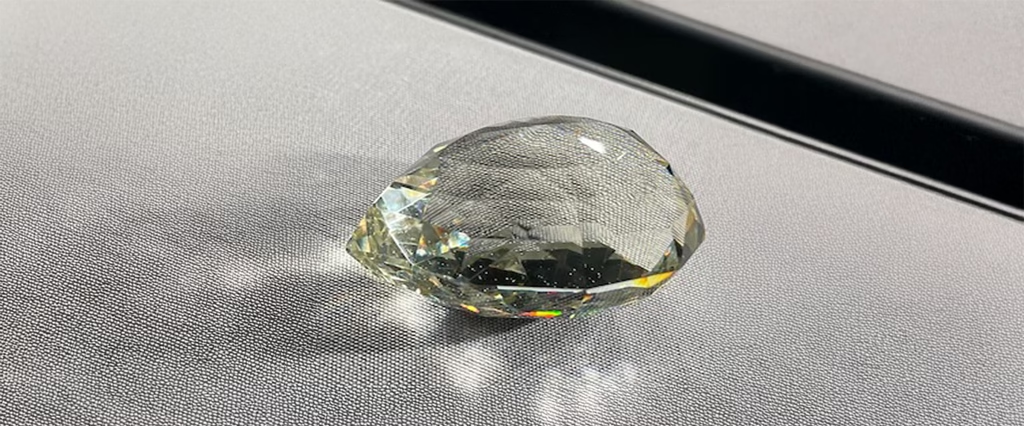
The moment of rediscovery was understated yet profound. The diamond, along with other family jewels, was carefully unwrapped from yellowed paper within the old suitcase. Its distinctive cut and radiant golden hue were instantly recognizable from historical illustrations and photographs. To confirm its authenticity, Christoph Köchert, of the esteemed Viennese jewelry firm A.E. Köchert, which once served as the imperial court jeweler, examined the stone. He verified that its unique nine-sided, 126-facet double rose cut and its weight of 137.27 carats perfectly matched the historical records, leaving no doubt that this was the genuine, long-lost Florentine Diamond.
A Gem of Legendary Provenance and Enduring Beauty
The Florentine Diamond’s history is as rich and complex as its dazzling facets. Believed to have been mined in the legendary Golconda region of India in the 15th century, its journey through the centuries is a tapestry woven with the threads of European royalty. Early legends connect the diamond to Charles the Bold, the Duke of Burgundy, who is said to have worn it into battle in 1477, only to lose it upon his death.
The first documented mention of the diamond dates to 1657, when the famed French gem merchant Jean-Baptiste Tavernier saw it in the possession of the powerful Medici family of Florence. A symbol of their immense wealth and influence, the diamond became synonymous with the grandeur of the Renaissance. With the decline of the Medici dynasty in the 18th century, the Florentine Diamond passed to the House of Habsburg through the marriage of Francis Stephen of Lorraine to Empress Maria Theresa of Austria. It was even set in the crown of Francis Stephen for his coronation as Holy Roman Emperor in 1745.
Described as having a pale yellow color with a slight greenish overtone, its unique double rose cut was designed to shimmer softly in the candlelight of European courts, a testament to the artistry of a bygone era.
A Future in the Public Eye: A Gesture of Gratitude
Having safeguarded this priceless heirloom for a century, the Habsburg family has no intention of selling it. Instead, they plan to honor the country that provided them with a safe harbor during their darkest days. The family intends to place the Florentine Diamond and other jewels in a Canadian trust, with the hope of displaying them in a Canadian museum. This act is a profound gesture of gratitude to the nation that welcomed Empress Zita and her children.
The reappearance of the Florentine Diamond is more than just the recovery of a lost gem. It is the closing of a chapter of mystery and the opening of a new one of public appreciation. It is a story of resilience, of a family’s dedication to preserving their heritage against all odds. The diamond that witnessed the rise and fall of empires, that survived wars and revolutions, has finally returned to the light, its enduring brilliance a powerful symbol of history’s enduring legacy.
