


The Ultimate Holiday Gift Guide: Three Essential New Jewelry Books for the Discerning Collector
As the holiday season descends with its flurry of festivities, the perennial challenge of finding the perfect gift returns. For the jewelry lover in your life—whether they are a seasoned collector of high carat gemstones or a younger enthusiast curating their first vintage stack—the answer often lies not in a velvet box, but between the covers of a beautifully bound book. In an era where “quiet luxury” and intellectual curiosity are dominating fashion trends, gifting a heavy, knowledgeable tome is a statement in itself. It suggests a deep respect for the recipient’s passion and a desire to fuel their inspiration.
This year, three exceptional new releases stand out in the crowded publishing landscape. These are not merely coffee table decorations; they are comprehensive histories, passionate manifestos, and visual feasts that promise to captivate readers long after the holiday lights have been dimmed. From the democratizing revolution of costume jewelry to the opulent history of the 19th century and a poignant exploration of vanishing craftsmanship, these books are guaranteed to resonate with a diverse range of shoppers, particularly the Gen Z demographic who are currently reshaping the luxury market with their appetite for history, sustainability, and authenticity.

A Sparkling Revolution: Costume Jewelry
For decades, the term “costume jewelry” was often whispered with a hint of dismissal—an affordable alternative for those who could not access the “real thing.” However, history tells a far more compelling story. Since the 17th century, women of immense style and limited means have adorned themselves in “paste,” an artful, high-lead glass used to imitate gemstones. But it was in the 20th century that this category truly exploded, transforming from mere imitation into a celebrated art form in its own right.
In the forthcoming magnum opus Costume Jewelry, published by the venerable art book house Taschen, renowned jewelry expert Carol Woolton and fashion critic Maria Luisa Frisa present a definitive history of this vibrant genre. The book is anchored by the extraordinary collection of Patrizia Sandretto Re Rebaudengo, an Italian patron whose assemblage of nearly 600 pieces serves as the visual backbone of this narrative.
The Patrizia Sandretto Re Rebaudengo Collection
The volume is a visual tour de force, showcasing the “Patrizia Sandretto Re Rebaudengo Collection” in exquisite detail through the lens of photographer Luciano Romano. Rebaudengo’s collection traces the evolution of non-precious jewelry from the 1930s to the new millennium, offering a unique window into the social and economic shifts of the last century. Readers are treated to a parade of imaginative designs that prove value is not solely determined by carat weight. The book highlights how, in the wake of the Great Depression and two World Wars, jewelry became a morale booster and a vehicle for self-expression that transcended class boundaries.
Democratizing Luxury: From Bakelite to Hollywood
Woolton’s text masterfully illuminates how New York City became the epicenter of this design revolution. As artisans fled war-torn Europe, they brought with them old-world techniques that they applied to new, humble materials. The book explores the creative explosion involving materials like Bakelite, Lucite, and colorful rhinestones. Designers of the mid-20th century followed in the footsteps of couturiers like Coco Chanel and Elsa Schiaparelli, who famously mixed fine gems with costume pieces, effectively democratizing fashion.
The narrative delves into the golden age of Hollywood, where costume jewelry adorned the necks and wrists of silver screen icons, further cementing its status as a symbol of glamour. By exploring the works of legendary brands such as Trifari, Marcel Boucher, and Miriam Haskell, the book illustrates how these “frivolous” objects were actually radical tools of identity and rebellion. Structured almost like a musical playlist, with chapters paired with songs like “Diamonds Are a Girl’s Best Friend,” this book is an immersive cultural experience that will inspire modern designers and collectors to look at plastic and glass with fresh, reverent eyes.
A Masterclass in History: The Age of Grandeur
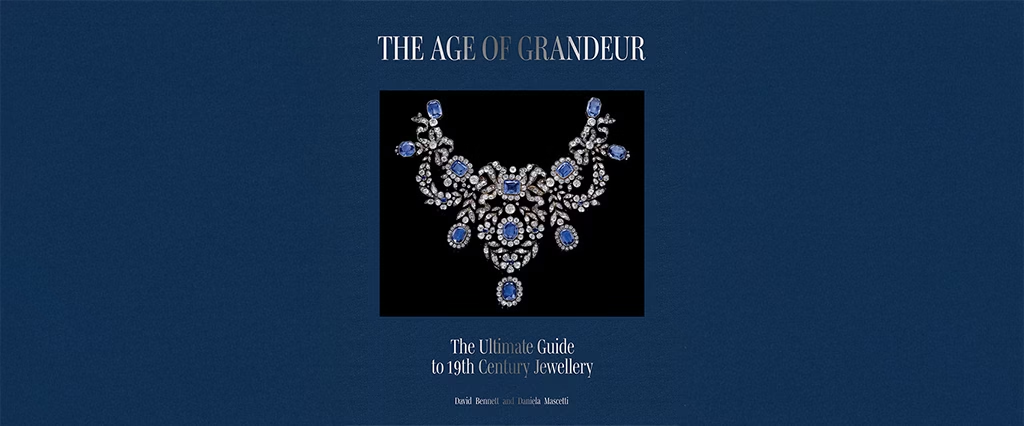
While some look to the future, a significant portion of the jewelry world—fueled by a massive surge in interest from Gen Z—is looking steadfastly at the past. The appetite for vintage and antique jewelry has never been higher, driven by a desire for sustainable consumption and unique, one-of-a-kind storytelling. For those seeking a proper education on the foundations of modern jewelry design, there is no better guide than The Age of Grandeur: The Definitive Guide to 19th-Century Jewellery From the Classical and Romantic to Art Nouveau.
Decoding the 19th Century
Published by ACC Art Books, this volume is the work of two of the industry’s most respected heavyweights: Daniela Mascetti and David Bennett. As the authors of the seminal reference work Understanding Jewellery, their authority is undisputed. In this new standalone volume, they turn their laser focus to the 1800s, a century of immense change and artistic fertility. The book features over 250 stunning new color photographs that bring the era to life, allowing readers to examine the intricate details of craftsmanship that defined the age.
The 19th century was not a monolith of style; it was a dynamic progression of movements. Mascetti and Bennett guide the reader through the austere elegance of Napoleonic classicism and the sentimental, symbolic language of Victorian memorial jewels. They explore the Romantic era’s obsession with naturalism, where brooches and tiaras bloomed with diamond flowers and enamel leaves. The narrative continues through the Archaeological Revival—sparked by excavations in Italy and Greece—which saw a return to gold granulation and Etruscan forms, before culminating in the fluid, organic, and often rebellious lines of Art Nouveau.
The Vintage Renaissance for a New Generation
For the younger client who is just discovering the world of antique jewelry, The Age of Grandeur is an essential roadmap. It provides the context needed to understand why a piece looks the way it does. Understanding the shift from the “Grand Period” of the mid-century to the “Fin de Siècle” helps collectors appreciate the rarity and technique behind the pieces they see in auction catalogs or on Instagram. By offering deep insights into the themes, styles, and goldsmithing techniques treasured by earlier generations, Mascetti and Bennett have created a resource that empowers the modern buyer to collect with confidence and intelligence.
The Soul of the Maker: Craftland
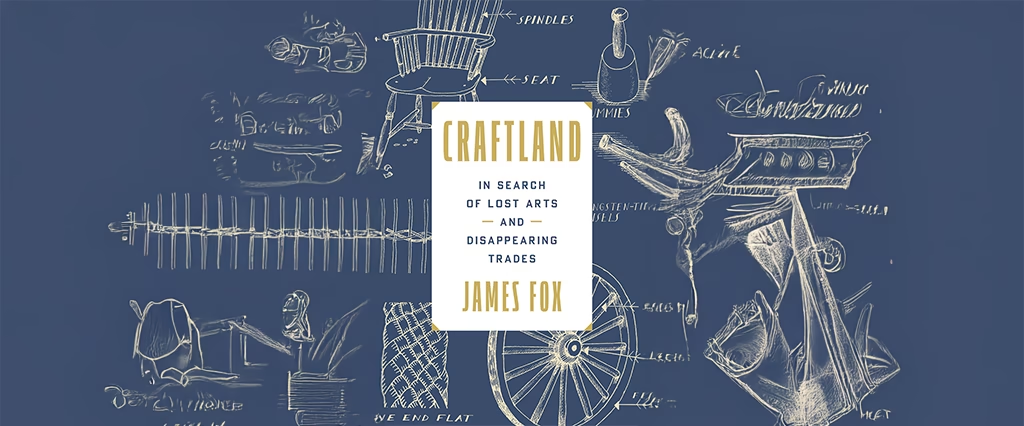
In an age dominated by algorithms, mass production, and the sterile aesthetic of machine-made goods, there is a profound, growing hunger for the “human touch.” This sentiment is at the heart of the third must-have book of the season: Craftland: In Search of Lost Arts and Disappearing Trades by James Fox. While not exclusively a jewelry book, its core philosophy strikes a resonant chord with anyone who values the art of adornment and the skill of the human hand.
In Search of Vanishing Trades
James Fox, a celebrated art historian at the University of Cambridge, takes readers on a poignant travelogue through Britain, seeking out the hidden histories of the nation’s heritage of craftsmanship. Fox warns that many of the oldest artisanal traditions are teetering on the brink of extinction. His journey introduces us to a cast of extraordinary characters: dry stone wall builders in West Yorkshire, rush weavers in Bedfordshire, and coopers (barrel makers) in Northern Ireland.
Crucially for the jewelry enthusiast, the book also touches upon trades that share the DNA of the jeweler’s bench, such as the cutlers of Sheffield and the intricate work of watchmakers. Fox illuminates the dedication, the muscle memory, and the tacit knowledge required to manipulate raw materials into functional art. He captures the smells of the workshop, the sound of the hammer, and the quiet focus of the artisan—sensory details that will feel intimately familiar to anyone who has ever sat at a jeweler’s bench or watched a goldsmith at work.
Why Craft Matters in a Digital Age
Craftland is more than a history lesson; it is a passionate manifesto for the future of consumption. Fox argues compellingly for a return to “buying less and spending more”—a philosophy that aligns perfectly with the ethos of investing in fine jewelry. He posits that objects made by human hands possess a soul and a longevity that mass-manufactured items can never replicate.
“Craft can happen anywhere, even in the most seemingly boring places, even in retail parks and industrial estates and cul-de-sacs and converted garages,” Fox asserts. “Manufacturing was such an ever-present part of our past that wherever you grow up, you can find these great craft stories, these great manufacturing histories and their legacies all around you.”
For the jewelry lover, Craftland serves as a powerful reminder of the value of the “maker.” It validates the premium paid for hand-engraving, for hand-set stones, and for the unique imperfections that denote a piece was born from human effort rather than robotic precision. It is a book that will inspire readers to seek out local artisans and to cherish the handmade treasures they already own.
The Gift of Knowledge
This holiday season, the most luxurious gift you can offer is not necessarily gold or diamonds, but the stories and knowledge that give those materials meaning. Whether it is the dazzling, democratic history of Costume Jewelry, the scholarly depth of The Age of Grandeur, or the soulful advocacy of Craftland, these three books offer a richness that will outlast the festive season. They are invitations to explore, to learn, and to appreciate the artistry that adorns our lives, making them the ultimate stocking stuffers for the thoughtful collector.