


Unearthing a Legend: The “Massive” 41.82 Carat Blue Diamond Discovery That Could Rewrite History
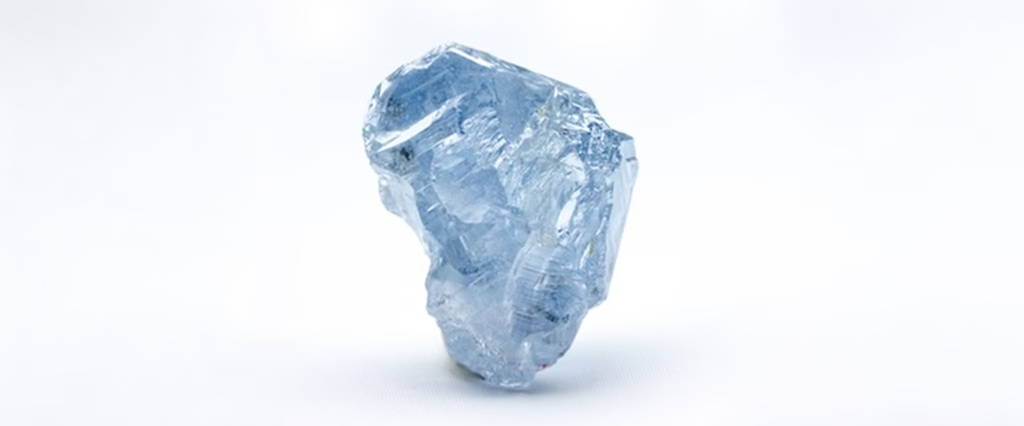
In the world of gemology, there are discoveries, and then there are miracles. This week, the rich soils of South Africa delivered the latter. Petra Diamonds has announced the recovery of a staggering 41.82-carat blue diamond from its legendary Cullinan mine, a find that has sent shockwaves of excitement through the global luxury market. Described by experts as “massive” and “almost unbelievable,” this rare gemstone is not merely a mineral specimen; it is a geological anomaly that is poised to become one of the most significant blue diamonds ever offered to the public.
The Discovery: 41.82 Carats of Perfection
The announcement came from Petra Diamonds, the custodians of one of the world’s most storied diamond archives. The stone, weighing in at a substantial 41.82 carats, was recovered from the Cullinan mine, a location synonymous with the world’s most gigantic and pristine gems. While the mine produces diamonds regularly, a blue diamond of this magnitude is a statistical impossibility that somehow became reality.
In their official statement, Petra Diamonds exercised the cautious optimism typical of the industry, yet the excitement was palpable. They described the type IIb diamond as being of “seemingly exceptional quality in terms of both its color and clarity.” In an industry where a single flaw can reduce a diamond’s value by millions, the phrase “exceptional quality” serves as a signal to the world’s wealthiest collectors that a new king of gems has arrived.
The company noted that it is currently “in the process of analyzing the stone and ascertaining the preferred method of sale.” This period of analysis is critical. Master cutters and gemologists will now use advanced scanning technology to map the interior of the rough stone, plotting a course to release the most brilliant polished gem possible from its rough exterior.
Industry Shockwaves: “Almost Unbelievable”
The reaction from the diamond community has been immediate and euphoric. Grant Mobley, the jewelry and watch editor for Only Natural Diamonds, did not mince words when assessing the gravity of this find.
“Blue diamonds already occupy the rarest tier of natural gemstones,” Mobley wrote, underscoring the scarcity of the asset. “A blue diamond of this size, recovered from one of the world’s most storied mines, immediately invites comparison to some of the most valuable diamonds ever sold.”
Mobley went further, calling the 41.82-carat stone “massive” and “almost unbelievable,” predicting that it “could rewrite the record books.” His assessment reflects a market truth: while white diamonds are graded on a predictable curve of value, large, high-color blue diamonds exist in a stratosphere of their own. When a stone like this appears, it doesn’t just follow market trends; it sets them. The anticipation is that this gem will not only break price-per-carat records but potentially challenge the total sale records for blue diamonds at auction.
The Science of Scarcity: Why Type IIb Matters
To understand the fervor surrounding this 41.82-carat stone, one must understand the geological lottery required to create it. Petra Diamonds identified the stone as a “Type IIb” diamond. To the layperson, this technical classification might seem obscure, but to investors, it is the gold standard of rarity.
Type IIb diamonds make up less than 0.1% of all natural diamonds found on Earth. Unlike common diamonds, which are composed of pure carbon or contain nitrogen impurities (which give diamonds a yellow tint), Type IIb diamonds contain trace amounts of the element boron within their crystal lattice structure. It is this boron that bestows the diamond with its mesmerizing blue hue.
However, the presence of boron is a geological mystery. Boron is typically found in the Earth’s crust, yet diamonds form hundreds of miles deeper, in the mantle. For a Type IIb diamond to form, tectonic plates must subduct, dragging boron-rich ocean floors deep into the mantle where the boron can be incorporated into the forming diamond. The stone then returns to the surface via violent volcanic eruptions in kimberlite pipes. Essentially, every Type IIb blue diamond is a survivor of a billion-year journey that geology suggests shouldn’t happen. A 41-carat survivor is nothing short of a miracle.
The Cullinan Legacy: The Cradle of Giants
The provenance of a diamond is often as valuable as the stone itself, and this new discovery boasts the most prestigious lineage in the diamond world. The Cullinan mine is not just a hole in the ground; it is a monument to the Earth’s treasures.
Petra Diamonds purchased the Cullinan mine from De Beers in 2007, inheriting a legacy that dates back to the early 20th century. The mine is most famous for the 1905 discovery of the “Cullinan Diamond,” a behemoth weighing 3,106 carats—the largest gem-quality rough diamond ever found. That historic stone was cut into several gems, including the Great Star of Africa, which now rests in the British Royal Sceptre.
However, in the modern era, the Cullinan mine has reinvented itself as the world’s primary source of ultra-rare blue diamonds. It is one of the very few geological formations on the planet capable of producing these boron-rich stones with any regularity. When a collector buys a Cullinan blue, they are buying a piece of history that sits alongside the Crown Jewels.
A Lineage of Record-Breakers
The 41.82-carat stone has big shoes to fill, but the mine’s track record suggests it is up to the task. The Cullinan has produced a succession of superstars that have captivated the auction world:
- The Blue Moon of Josephine: Discovered at Cullinan, this stone began as a 29.6-carat rough. After polishing, it became a 12.03-carat Fancy Vivid Blue masterpiece. In 2015, it sold at Sotheby’s for a staggering $48.5 million, setting a then-world record of over $4 million per carat.
- The De Beers Blue: More recently, the mine produced a rough stone weighing 39.34 carats. This was cut into the 15.10-carat “De Beers Blue,” a step-cut vision that fetched $57.5 million in 2022.
The new 41.82-carat find is heavier in its rough form than both of these predecessors. If the clarity and color saturation hold true during the cutting process, the resulting polished gem could exceed 15 or even 16 carats, potentially eclipsing the sale price of the De Beers Blue and establishing a new benchmark for global wealth.
The High Stakes of Cutting and Polishing
With the rough stone now secured, the “process of analyzing” mentioned by Petra Diamonds becomes a high-stakes game of geometry and risk. Cutting a blue diamond is vastly different from cutting a white diamond. In white diamonds, the goal is often to maximize light return (sparkle). In blue diamonds, the cutter must maximize color intensity.
The cutter will face a terrifying decision: preserve weight or enhance color? A larger stone with a lighter blue tone might be worth less than a slightly smaller stone with a “Fancy Vivid” or “Fancy Deep” grading. The rough stone will be scanned by lasers to detect any internal stress points or inclusions. One wrong strike on the polishing wheel could shatter the crystal, evaporating tens of millions of dollars in seconds.
The industry speculates that the rough diamond will likely yield a “Fancy Vivid Blue” polished stone, the highest possible color grading. If it retains a weight above 15 carats after polishing, it will enter an elite circle of gems that can be counted on one hand.
The Preferred Method of Sale
Petra Diamonds has stated they are determining the “preferred method of sale.” This usually boils down to two options: a private high-stakes tender or a public partnership with an auction house like Sotheby’s or Christie’s.
In a tender, the world’s top diamond manufacturers (diamentaires) submit sealed bids. This method ensures immediate liquidity for the mining company. However, given the “massive” nature of this find, a public auction could generate a media frenzy, driving the price up through competitive vanity bidding among billionaires and royalty. The narrative of the “41-carat Cullinan Blue” is a powerful marketing tool that Petra will likely leverage to its fullest extent.
Economic Implications for Petra Diamonds
This discovery comes at a crucial time. The diamond mining industry is capital-intensive and risky. Finding a stone of this caliber is akin to a small tech startup discovering a new source of clean energy. It provides a massive injection of revenue and, perhaps more importantly, boosts investor confidence.
Petra Diamonds has successfully navigated the transition of the Cullinan mine from an open pit to a modern underground operation. This find validates their geological models and engineering efforts. It serves as a reminder to shareholders and the market that the Cullinan kimberlite pipe still has significant treasures hidden within its depths.
Conclusion: A Stone for the Ages
As the world awaits the final analysis and eventual sale of this 41.82-carat marvel, one thing is certain: we are witnessing history in the making. In an era of lab-grown alternatives and mass production, the unearthing of such a unique natural treasure reminds us of the Earth’s capacity for wonder.
Grant Mobley’s description of the find as “almost unbelievable” captures the sentiment perfectly. It is a stone that defied the odds of formation, survived the violence of volcanic eruption, and escaped the crusher of the mining plant to emerge intact. Whether it ends up in a royal collection, a museum, or the vault of a private investor, the Cullinan 41.82-carat blue diamond is destined to be remembered as one of the greatest gems of the 21st century.