



Crowning the Queen Within: Tali Kogan’s Journey of Forging Strength into Jewelry
Some transformations are subtle, a quiet evolution over time. Others are explosive, born from the ashes of a former life. For Tali Kogan, the visionary founder of the demi-fine jewelry brand Malkari, her journey encompasses both. Today, she is a celebrated jewelry designer, a sought-after fashion stylist, and a beacon of empowerment for women everywhere. But to truly understand the radiant, powerful woman at the helm of a brand built on strength, one must first understand the life she had to leave behind—a life where she was an accountant, a wife, and a survivor. Her story is not just about design; it’s about the radical act of self-reinvention and how the right piece of jewelry can be more than an accessory—it can be armor.
The Shadow Before the Dawn: A Life in Hiding
Long before the shimmer of gold and the glint of gemstones defined her world, Tali Kogan’s life was one of spreadsheets and silence. Trained as an accountant, her identity was neatly boxed into logic and numbers. She was, by her family’s own admission, “the smart one.” It was a label meant as a compliment, but it carried an unspoken weight, an invisible boundary around her being.
“I was never told I was beautiful,” Kogan shares with raw vulnerability. “Not even by my own parents. They called me ‘the smart one,’ but never beautiful.” This subtle but persistent message burrowed deep, shaping her self-worth in ways she wouldn’t fully comprehend until much later. “I wondered later if I ended up in that marriage because of that—I never loved myself, I didn’t feel beautiful.”
The marriage she refers to was a period of profound darkness. “My first husband was a monster, and he was abusive,” she states, the words carrying the gravity of a past she has fought hard to overcome. In that environment, her sense of self eroded completely. She became a ghost in her own life, her wardrobe a reflection of her inner state. Her closet was a sea of “dark baggy clothes,” shapeless garments designed for one purpose: to disappear. It was a uniform of invisibility, a way to shrink herself so she wouldn’t be seen, judged, or hurt. She was hiding not just from the world, but from herself. The vibrant, creative spirit she possessed was locked away, dormant beneath layers of fear and pain.
The Catalyst for Change: Styling as Salvation
Every survivor’s story has a turning point—a moment when the will to live fully eclipses the instinct to simply survive. For Tali, that moment was a conscious, deliberate decision to fight back not with fists, but with fashion. She realized that to change her life, she had to change how she presented herself to the world. She had to shed the skin of her old life, starting with the very clothes on her back.
Dressing for the Life She Deserved
The transformation began in her closet. The dark, baggy clothes were cast aside, replaced with “bright, fun, expressive clothing.” This was not a frivolous act; it was a declaration of war against the darkness. Each colorful dress, each well-fitting piece, was a reclamation of her own body and her own narrative. She began dressing not for the life she had, but for the vibrant, joyful life she desperately wanted to build. It was an external manifestation of an internal rebellion, a way to physically wear the confidence she was determined to feel.
“I needed to show up differently in the world,” Kogan explains. This sartorial shift became a powerful daily ritual. As she chose her outfits, she was also choosing her attitude, her energy, and her future.
“Styling Became My Medicine”
The effect was so profound, so healing, that Tali recognized its therapeutic power. “Styling became my medicine,” she says. “This is how I healed myself and got myself from darkness to the light.” It was a potent prescription. Unlike traditional therapy that works from the inside out, styling offered an “outside-in” approach. By controlling her appearance, she regained a sense of agency that had been stolen from her. She was crafting a new identity, one outfit at a time.
Realizing the universal power of this process, she felt an overwhelming urge to share it. “Once I realized it would help me get through that part of my life, I’ve wanted to share it with other women. It’s a gift.” In 2007, while still working as an accountant, she took the first leap, launching a styling business called Tel Aviv Couture. She began translating her simple, empowering dressing principles to help other women find their own light.
The Birth of a Kingdom: The Genesis of Malkari
Styling was the medicine, but jewelry design became Tali’s true calling—the ultimate expression of her mission. The transition from stylist to designer was sparked by a single, transformative moment during a photoshoot. This was the birth of Malkari, a brand that celebrated its one-year anniversary in 2024, but whose roots run deep into Tali’s own story of survival and triumph.
The Lioness and the Epiphany
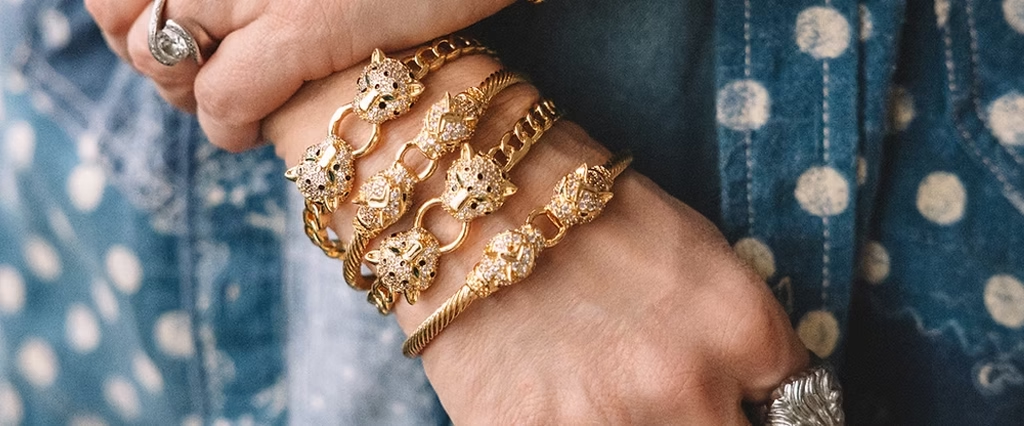
Tali was styling a client for a major photoshoot. This client was a Leo, an astrological sign known for its strength, resilience, and natural leadership. Tali envisioned a powerful, symbolic look. “She is a Leo, which means she is resilient and unstoppable. I wanted to dress her in a lion because that energy is something every woman needs,” Kogan recalls. She searched for the perfect statement piece of jewelry—a lion’s head—to complete the look, but nothing she found captured the raw, regal energy she was after.
Undeterred, Tali decided to create it herself. She collaborated with a designer in New York City, meticulously crafting the exact piece she had imagined. On the day of the shoot, she placed the custom lion jewel on her client. The change was immediate and breathtaking. It wasn’t just an accessory; it was an activation. The woman’s posture straightened, her gaze intensified, and a palpable aura of confidence filled the room. The lion jewel hadn’t just completed her outfit; it had transformed her demeanor.
Watching this metamorphosis, Tali had an epiphany. “Everything grew from there,” she says. She saw firsthand how a single, symbolic piece of jewelry could unlock a woman’s inner power. It was a talisman, a tangible reminder of the strength she possessed within.
Forging an Identity: The Meaning of Malkari
When it came time to name her new venture, Tali chose words that were as powerful and intentional as her designs. “The name itself is a declaration,” she explains. She fused two potent Hebrew words: Malka, meaning Queen, and Ari, meaning Lion.
Together, Malkari became “the embodiment of fierce femininity and regal strength.” It was the perfect name for a brand dedicated to helping women embrace their inner sovereign. In all her marketing and communication for the direct-to-consumer online brand, Tali refers to her clients and followers as “my queens.” This isn’t a marketing gimmick; it’s the core of her philosophy. She hopes that by hearing it, wearing it, and seeing it, they will begin to view themselves that way every single day. “That is why I want women to take care of themselves,” she insists. “They ‘call forth the queen’—that’s a key part of my work.”
The Royal Insignia: Symbolism Forged in Metal
Every piece in the Malkari collection is imbued with meaning. These are not just beautiful objects; they are storytellers, protectors, and catalysts for personal growth. The symbolism is the soul of the brand.
The Courage of the Lion and the Metamorphosis of the Butterfly
The lion, the genesis of the brand, remains a cornerstone. It represents courage, leadership, and the untamable heart of a warrior. It’s for the woman stepping into a new role, facing a challenge, or simply reminding herself of her own ferocity.
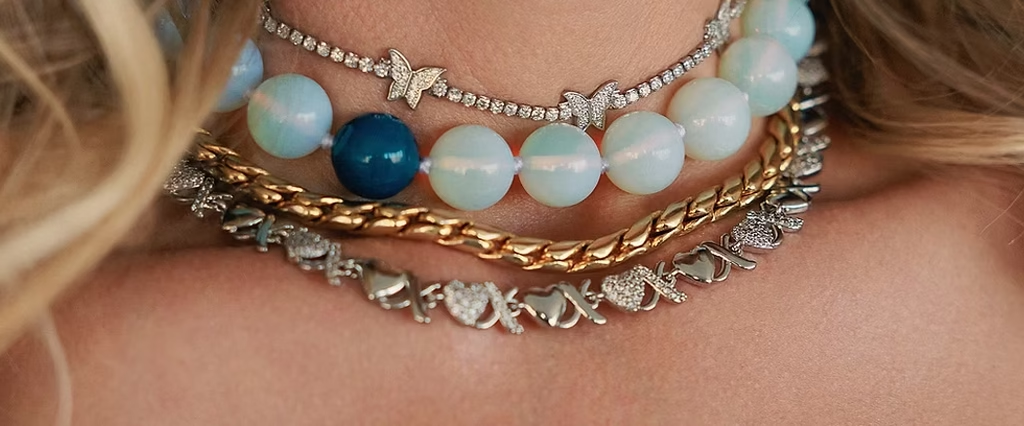
Another powerful symbol in the Malkari universe is the butterfly. This emblem is deeply personal to Tali, representing her own profound transformation. It speaks to the journey of emerging from a chrysalis—the dark, confined space of her past—and unfurling wings to embrace a new, vibrant, and colorful life. It is a symbol of hope, rebirth, and the beauty that comes after a period of struggle.
Adorning the Everyday Queen
While the statement pieces carry immense power, Tali understands that a queen must reign over her everyday life as well. Recently, she introduced beaded necklaces, designed to be layered or worn alone. She envisions them as the perfect flourish for a simple white t-shirt in summer, effortlessly elevating the mundane into something magical.
This philosophy of accessible adornment has built a fiercely loyal following. “My queens—once they try my jewelry, they don’t go back. They start collecting it,” Kogan says with a proud smile. She notes the practical appeal as well: “It’s easier to buy jewelry than more clothing because it doesn’t take up as much space.” It’s a collection that grows with a woman, marking milestones and celebrating her ongoing journey.
A Legacy of Empowerment: More Than Just Jewelry
Today, Tali Kogan is remarried and a mother to three children, her life a testament to the future she so bravely designed for herself. Malkari is more than a business; it is the culmination of her healing, a platform for her passion, and a tribute to the resilience of the female spirit.
She didn’t just survive her past; she alchemized it. She took the pain, the invisibility, and the struggle, and forged them into something beautiful, strong, and empowering for others. Tali Kogan’s journey shows that sometimes, the most important transformation isn’t just about changing your circumstances, but about changing how you see yourself. And it can all begin with the radical, regal act of choosing to wear a crown.