


The Golden Era: Why Jewelry Is Poised to Be Fashion’s Fastest-Growing Category in 2026
In a global luxury market currently navigating economic turbulence, shifting consumer priorities, and a general softening of demand, one category stands out as a resilient, glittering exception: jewelry. While apparel and leather goods face the headwinds of a “luxury slowdown,” jewelry has not only defied the odds but is actively accelerating.
According to the highly anticipated “The State of Fashion 2026” report, released jointly by the management consultancy McKinsey & Co. and The Business of Fashion (BoF), jewelry is projected to be the single fastest-growing business within the fashion ecosystem over the next few years. This isn’t just a fleeting trend; it represents a fundamental structural shift in how consumers view value, identity, and investment.
The Resilience of Hard Luxury: Investment Meets Emotion
To understand the jewelry boom, one must first look at the psychology of the modern luxury consumer. In periods of economic uncertainty—marked by inflation and fluctuating markets—shoppers tend to pivot away from “soft” luxury items like clothing and shoes, which are prone to wear and tear, toward “hard” luxury assets that retain value.
The McKinsey & BoF report highlights this unique dual appeal. “This momentum reflects jewelry’s unique role as both an emotional and financial value store,” the report states. In an era where consumers are scrutinizing every dollar spent, jewelry offers a sense of permanence that a seasonal handbag simply cannot match.
The data supports this behavioral shift. When researchers asked consumers to compare various luxury categories based on their investment potential, jewelry ranked at the absolute top—surpassing handbags, watches, and other accessories by a significant 15 percentage points. This perception of jewelry as a “safe haven” asset is driving sales in both the costume and fine jewelry sectors, with both predicted to see sales gains above 5% annually in the coming years.
The Brand Revolution: From Generic to Iconic
Historically, the global jewelry market was highly fragmented and dominated by unbranded, local, or family-owned jewelers. However, a seismic shift is underway. We are witnessing the “branding” of the jewelry industry, a transformation that mirrors what happened to the watch industry decades ago.
Growth in the coming years will be driven largely by branded jewelry, which analysts note now comprises 25% of the total market. While this might seem like a minority share, its trajectory is explosive. Between 2021 and 2024, sales of branded jewelry grew at an impressive rate of 8.3% per year, far outpacing the nonbranded segment.
The Power of Iconography
Why are consumers flocking to big-name brands? The answer lies in the power of visual language. The report’s authors note that “unlike unbranded pieces, branded jewelry often carries its own iconography and symbolic language—a shorthand for identity.”
In a social-media-driven world, a recognizable silhouette—such as a screw-motif bracelet, a serpent-shaped ring, or a specific interlocking logo—signals status, taste, and belonging much more effectively than a generic diamond stud. For the modern consumer, buying into a brand is buying into a tribe and a story. This “shorthand for identity” is compelling shoppers to pay a premium for signed pieces, fueling the branded sector’s rapid ascent.
The “Treat Yourself” Phenomenon: The Rise of Self-Purchasing
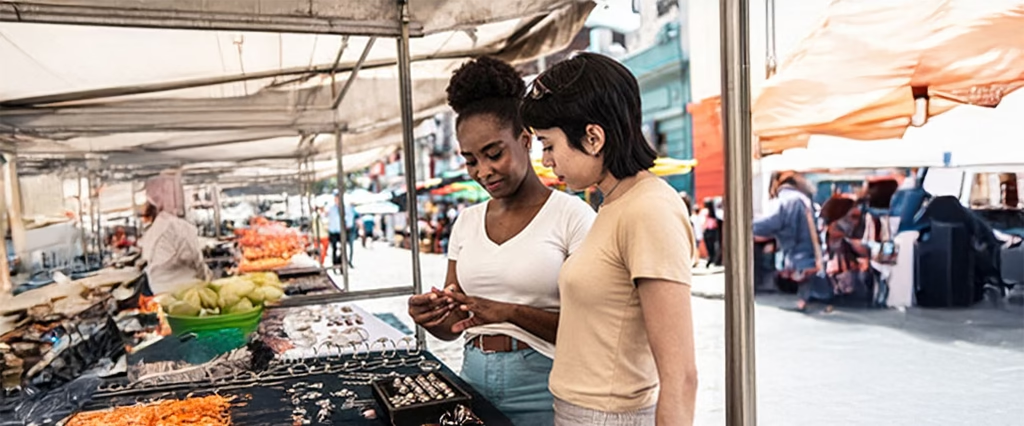
Perhaps the most culturally significant finding in the “State of Fashion 2026” report is the death of the “waiting to be gifted” mindset. The industry is no longer dependent on husbands buying anniversary gifts or partners purchasing engagement rings. Instead, the market is being propelled by women with their own spending power.
Researchers found that self-purchasing has evolved into a massive commercial opportunity. Sales of jewelry classified as “self-gifts” have skyrocketed, growing by an astounding 58% since 2021.
Redefining Ownership
This “self-purchase craze” is reshaping product development and marketing. Women are buying distinct, fashion-forward pieces to mark personal milestones—a promotion, a birthday, or simply the desire for something beautiful—rather than waiting for a romantic occasion.
Crucially, this trend disproportionately benefits branded products. When buying a gift for oneself, a consumer is more likely to seek out a brand that aligns with their personal values and aesthetic identity. The act of purchasing a branded piece becomes a declaration of independence and financial autonomy, further cementing the bond between the consumer and the luxury house.
Breaking Boundaries: The Explosion of Men’s and Gender-Fluid Jewelry
While women’s self-purchasing is a volume driver, the most dynamic growth in terms of percentage is coming from an unlikely source: men. The report indicates that while men’s jewelry currently represents a smaller slice of the overall market pie, it is expanding at a faster clip than the women’s segment.
Analysts forecast that the men’s jewelry sector will grow by 7% to 8% annually, significantly outstripping the 4% to 5% growth projected for women’s jewelry. This surge is being fueled by a cultural renaissance in men’s fashion, where accessories are no longer limited to a wedding band and a watch. From pearl necklaces to signet rings and sculptural brooches, men are embracing jewelry as a central tool for self-expression.
The Shift Toward Universal Design
To capitalize on this booming demographic, the report offers strategic advice for jewelers: stop thinking in binary terms. It recommends that brands adopt “modular, minimalist, and sculptural designs that transcend traditional gender categories.”
The future of retail layout and digital marketing must also adapt. The report suggests “reducing gendered product segmentation—both in-store and online—and marketing existing pieces as universal.” By removing the friction of “men’s” versus “women’s” sections, brands can appeal to a younger, more fluid generation of consumers who prioritize aesthetics over traditional gender labels.
The Diamond Dilemma and Opportunity: Natural vs. Lab-Grown
No discussion of the future of jewelry is complete without addressing the disruptive force of lab-grown diamonds (LGDs). The report predicts that the appetite for these man-made stones will not just continue but accelerate.
McKinsey and BoF forecast that lab-grown diamond sales will rise by 15.6% annually in the years ahead. This growth is being fueled by widespread adoption in key markets including the United States, India, and China. The statistics are staggering: while lab-grown diamonds currently account for nearly 20% of global diamond jewelry sales, the study suggests that this number could skyrocket to 50% by 2030.
Differentiating Value Propositions
This rise presents a complex challenge for the industry. The report notes that overall diamond sales (combining natural and lab-grown) will rise 4% to 5% a year. However, it noticeably refrains from providing a specific growth estimate for natural diamonds alone, implying a potential stagnation or loss of market share for mined stones.
The advice for retailers is clear: clarity is key. Retailers and brands “should define a clear approach” to the category. They must “clearly differentiate marketing between natural and lab-grown diamonds to emphasize distinct value propositions.”
Successful brands will likely bifurcate their strategies. They will market natural diamonds as rare, finite miracles of nature that hold store-of-value potential (investment), while positioning lab-grown diamonds as ethical, accessible, and fashion-forward choices that allow for larger carat sizes at a fraction of the price (fun and style).
Conclusion: A Sparkling Future
As the fashion industry braces for a challenging 2026, the jewelry sector shines as a beacon of opportunity. By leveraging the dual power of emotional connection and investment value, embracing the rise of powerful brands, catering to the self-purchasing woman, and unlocking the potential of the male consumer and lab-grown technology, jewelry is not just surviving the luxury slowdown—it is defining the new standard for success.