


How I Got Here: Randi Molofsky Turns Her Keen Jewelry Sense to Vintage
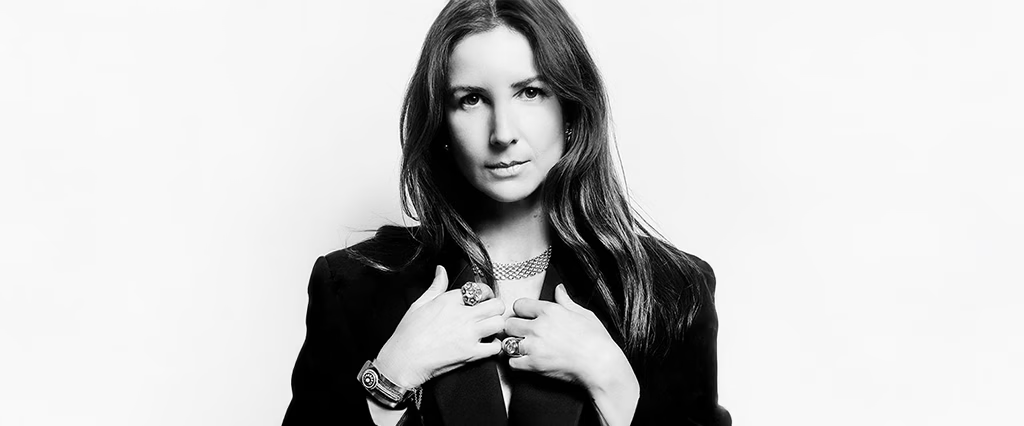
Call it Randi Molofsky’s “back to the future” era. The jewelry expert, widely recognized for her exquisite sense of what is modern and about to trend, is now aggressively growing a business focused entirely on the past.
Molofsky is best known within the fine jewelry industry for her multifaceted career as a journalist and as the founder of For Future Reference (FFR), a premier brand development agency that serves as a showroom for avant-garde independent designers like Retrouvaí and Harwell Godfrey. However, with her rapidly expanding For Future Reference Vintage brand, she is sharing her personal obsession with jewelry and watches dating back to the Victorian, Edwardian, and Art Deco periods, bringing a fresh, fashion-forward eye to the world of estate jewelry.
A Curatorial Pivot to the Past
Although For Future Reference Vintage is only a year old, it has already established a formidable footprint in the luxury retail landscape. The collection is now available through elite retailers such as Bergdorf Goodman in New York City, Twist in Seattle and Portland, and Department in Nashville. It also recently made its debut at Bloomingdale’s in Costa Mesa, California’s South Coast Plaza, signaling a major shift in how department stores are viewing the vintage category.
The venture didn’t happen in a vacuum. It was born out of a strategic partnership with Excalibur Jewelry, a legendary Los Angeles-based family business run by Kurt and Amy Rothner. Since 1981, Excalibur has been a go-to source for connoisseurs, and by combining their deep inventory with Molofsky’s stylist eye, FFR Vintage has created a unique niche.
“I always say: Nothing haunts you like the vintage you don’t buy. Especially with unsigned pieces, these are one-offs that you may or may not ever see again,” Molofsky says. “If you fall in love with something, don’t hesitate, because the next something similar you find could cost twice as much.”
The Appeal of “Unsigned” Treasures
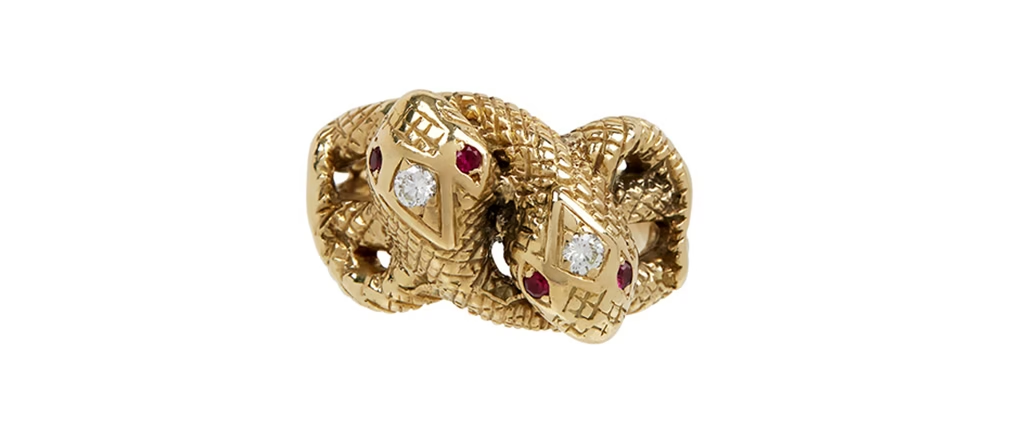
One of the most distinct aspects of Molofsky’s curation is her focus on unsigned statement pieces. While the auction world often obsesses over signed pieces from houses like Cartier or Van Cleef & Arpels, Molofsky champions the craftsmanship and aesthetic value of anonymous works.
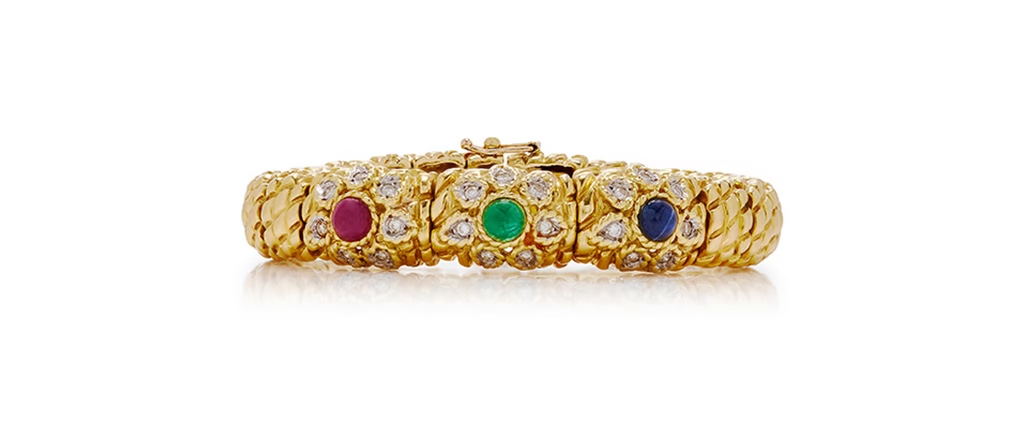
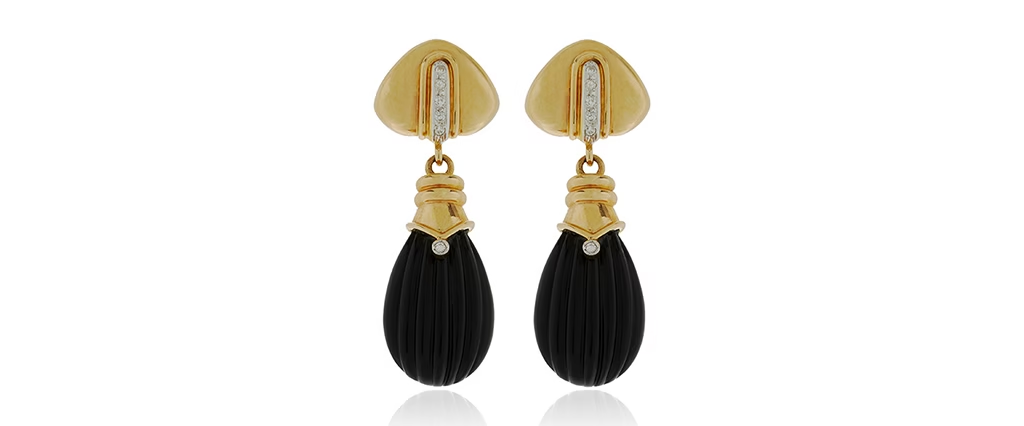
By focusing on unsigned jewelry—particularly bold gold collars from the 1970s, chunky 1980s onyx earrings, and intricate Victorian lockets—FFR Vintage offers a tremendous value proposition. Clients can acquire substantial, high-quality gold and gemstone pieces for a fraction of the price of a signed equivalent, without sacrificing style.
“We decided to focus specifically on unsigned statement pieces that we could curate and bring to retail partners to sell in their stores without having to source it themselves,” Molofsky explains. This strategy allows modern women to build a collection based on design and beauty rather than just brand names.
As Seen on Stars: The Celebrity Vintage Boom
The timing of Molofsky’s pivot to vintage could not be more perfect, as Hollywood’s elite have begun to embrace sustainable luxury on the red carpet. FFR Vintage has quickly become a stylist favorite, landing placements on some of the world’s most photographed women.
“Seeing the jewelry worn by luminaries including Jennifer Lopez, Rihanna, Halle Berry, Serena Williams, and Mikey Madison has been a superfun bonus,” she adds.
Perhaps the most viral moment for the brand came when pop superstar Taylor Swift was spotted cheering on the Kansas City Chiefs wearing a vintage 1970s coin necklace from For Future Reference Vintage. The piece, featuring an ancient bronze coin set in 14k gold, sparked an immediate trend, proving that pre-loved jewelry resonates deeply with the modern zeitgeist. Swift also donned a white gold Omega chain from the collection for the VMAs, further cementing the brand’s status.
The Making of a Tastemaker
A lifelong pursuit of taste, beauty, and sparkly things has brought Molofsky to this new enterprise, one that she says truly tells her story within jewelry. Interestingly, she had no family ties to the professional jewelry world growing up outside Annapolis, Maryland. Her entry into the world of gems was purely organic, sparked by studying her grandmother’s jewelry box for treasures.
“My grandmother had a flexible gold and diamond band with ‘X’ motifs that I was obsessed with,” Molofsky recalls. “It was the first piece that really made me look at construction and design.”
Yet her skills didn’t evolve out of nowhere. Let’s just say that Molofsky was always cool—like, even in elementary school she was setting trends and making her style look effortless, modern, and fresh.
“I always loved accessories,” she says. “According to my mom, when I was about 5, I refused to ever leave the house without wearing a belt, even with bathing suits.”
This early sartorial confidence paid off. “I was also voted ‘Best Dressed’ by my senior class—I think that superlative, paired with my budding journalism career, started to foreshadow what’s to come.”
From Print to Polish: The Journalism Years
After working on her high school newspaper, Molofsky pursued journalism in college, attending James Madison University in Virginia. She graduated with honors from its esteemed School of Media Arts and Design, with a concentration in print journalism, in 2000.
“I wrote for the school paper and was the youngest-ever editor of a human interest magazine called Curio, teaching me so much about finding great story ideas and the interview process,” she says. “After graduation, I immediately moved to NYC, hoping to find a gig that would combine both writing and fashion in some way.”
She started interviewing at major fashion magazines, encountering the typical “Devil Wears Prada” entry-level obstacles. However, she also applied for a fashion editor opening at a trade title called National Jeweler, then a prominent twice-monthly print publication.
A Trial by Fire
“The editor at the time, Donna Frischknecht, for one reason or another took a chance on me, even though I had zero jewelry experience,” Molofsky says.
It was an immersion therapy education. “Pretty quickly I was thrown straight into the fire—attending trade shows, meeting designers, interviewing retailers, and going on press trips around the world to gemstone mines and jewelry fairs—and I was bitten by the jewelry bug immediately.”
This period was crucial for Molofsky. She wasn’t just looking at pretty things; she was learning the “language” of jewelry—understanding the supply chain, the difference between commercial and couture quality, and the global economics of gold and diamonds.
Defining the Modern Collector
She went freelance in 2003, a move that allowed her to explore different facets of the industry. Two years later, she was commissioned to write a book called “A Girl’s Guide to Buying Diamonds.”
The book capitalized on a major cultural shift: the trend of the “right-hand ring.” For the first time, marketing campaigns were aggressively targeting women who wanted to buy jewelry for themselves rather than waiting for a partner to gift it. This compact, illustrated guide to the basics of jewelry provided a gateway to some of her future projects and established her as a voice for the self-purchasing female consumer.
Molofsky added public relations consulting to her freelance work, and in 2007 she became the chief curator for Portero, a luxury website that was a forerunner of the current online pre-owned boom.
At Portero, she learned about content creation, social media, and the intricacies of secondhand luxury. She got to dig deeper into luxury categories including jewelry, watches, handbags, fashion, and art. This experience gave her early insight into the “circular economy” long before sustainability became a buzzword.
The Gemfields Chapter: Ethical Sourcing
In 2012, her career took another global turn. She joined Gemfields, the London-based mining and marketing company that was a leading supplier of responsibly sourced rare colored gemstones, specifically emeralds from Zambia and rubies from Mozambique.
As the U.S. director of marketing and communications, she bridged the gap between the raw earth and high fashion.
“It all came full-circle: I was working with designers to create one-of-a-kind collections, conceptualizing multimillion-dollar ad campaigns, taking journalists to Africa to learn more about the mining experience, and overseeing all of the PR for the brand in the United States,” Molofsky says.
The West Coast Expansion
A move to Los Angeles in 2015 led her to start a blog and work with emerging jewelry brands on PR and marketing. That segued into the founding of For Future Reference, which handles both wholesale and public relations for fine jewelry designers.
For Future Reference has been going strong for a decade now. Under Molofsky’s guidance, the agency has helped launch the careers of some of the most exciting names in modern jewelry. But even while championing the “new,” the pull of the “old” remained.
During her time running the agency, Molofsky dived into the vintage and pre-owned worlds again. She had been selling vintage jewelry and watches to private clients for years, cultivating a reputation as a treasure hunter.
“I wanted to see how we could partner to do something together,” she says of her relationship with Excalibur. “So, in 2024, For Future Reference Vintage was born.”
Today, Randi Molofsky stands at the unique intersection of the industry’s past and future. whether she is spotting the next big indie designer or unearthing a 1970s gold collar that looks just right on a modern pop star, her goal remains the same: connecting people with pieces that tell a story.
“I’m a statement jewelry kinda gal,” she admits. And thanks to her efforts, a new generation of collectors is learning to make a statement with history.