


The Looming Threat: How U.S. Tariffs Are Shaking the Foundations of the Colored Gemstone Industry
In the glittering world of colored gemstones, where beauty is measured in carats and rarity translates to value, a formidable and unwelcome shadow has fallen. This threat isn’t a newly depleted mine or a shift in consumer taste; it’s a matter of economic policy. U.S. tariffs, according to the American Gem Trade Association (AGTA), represent the single most significant danger the industry has faced in modern history. This stark warning was the central theme of a critical seminar, “Talking Tariffs,” held in the heart of New York City’s jewelry district, where industry leaders gathered to confront a challenge that could irrevocably alter their supply chains, business models, and very survival.
A Clear and Present Danger: The AGTA Sounds the Alarm
The message delivered by AGTA CEO John Ford on July 23 was anything but subtle. Addressing a room of concerned stakeholders, from importers to jewelry designers, Ford declared that the current U.S. tariff landscape poses “the biggest threat to the colored gemstone industry the American Gem Trade Association has ever seen.” His words painted a picture not of a minor business hurdle, but of a potential existential crisis.
The AGTA, as the leading authority and advocate for the natural colored gemstone sector, has not been idle. Ford confirmed that the association is actively engaged in high-stakes discussions with members of Congress and officials from the administration, tirelessly making the case for a crucial exemption. Their argument is not merely about protecting profits; it is about preserving a unique, globally interconnected industry that operates unlike many others.
The Core of the Argument: Why Gemstones Are a Unique Case
To understand the severity of the threat, one must first grasp the unique economic and geological realities of the colored gemstone trade in the United States. The AGTA’s lobbying efforts, spearheaded by Frank Phifer, senior vice president of the firm Hecht, Latham, Spencer & Associates, are built on a foundation of several key arguments that distinguish gemstones from other tariffed goods.
A Net Exporter in a Sea of Imports
One of the most compelling points, as Ford highlighted, is the industry’s status as a net exporter. “Loose colored gemstones are a little different from diamonds in that we are a net export,” he explained. This statement may seem counterintuitive, but it reveals the sophisticated role the U.S. plays in the global jewelry market.
The United States does not primarily consume loose gemstones. Instead, American businesses import rough or pre-cut stones from mining countries across the globe. These gems are then masterfully incorporated into high-end jewelry designs by skilled American artisans and manufacturers. The finished product—a stunning piece of jewelry featuring a Colombian emerald or a Burmese ruby—is then often exported to international markets. The value added within the U.S. through design, craftsmanship, and marketing is immense. Tariffs on the raw material (the loose gems) directly attack this value-add process, jeopardizing a successful export-oriented business model.
The “Geologically Unavailable” Defense
Phifer drove home the most fundamental argument: the United States simply does not have the geology to be a major producer of the vast majority of colored gemstones. “Loose colored gemstones are not geologically available in the United States,” he stated plainly.
While the U.S. has some domestic gems, like the famed Montana sapphire or Oregon sunstone, it lacks commercial-scale deposits of ruby, emerald, tanzanite, alexandrite, and countless other stones that form the backbone of the industry. The AGTA is therefore arguing that these gems should be treated like “critical minerals,” many of which are exempt from tariffs precisely because they are essential for industry and not found domestically. “Without the availability, these tariffs become punitive and disrupt the supply chain,” Phifer asserted. The tariffs don’t protect a non-existent American gemstone mining industry; they merely punish the American jewelry industry that relies on a global supply.
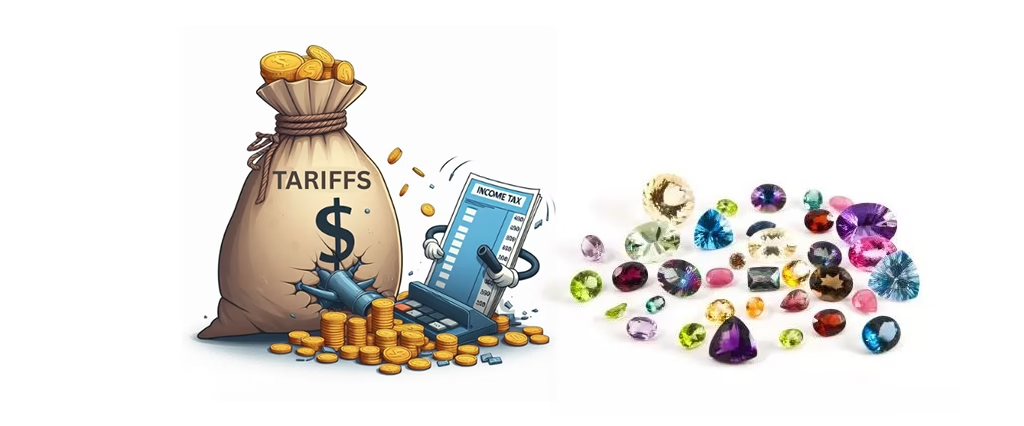
The Montana Sapphire Paradox: A Case Study in Global Interdependence
To illustrate this point with perfect clarity, John Ford offered a powerful local example: the Montana sapphire. Here is a gemstone mined on American soil, a source of national pride. Yet, even these homegrown treasures are not immune to the disruptions caused by tariffs.
“An example is the Montana sapphire,” Ford noted. “They have to be cut overseas because the industry to cut that melee economically does not exist here.” The small, accent-sized sapphires (melee) require a highly specialized and labor-intensive cutting process. The economic infrastructure and skilled workforce for this specific task are concentrated in countries like Thailand and Sri Lanka. Therefore, American-mined sapphires are exported for cutting and then re-imported. If tariffs are applied upon their return, an American product is essentially being taxed, creating a logistical and financial nightmare that underscores the industry’s deep reliance on a global network of specialized skills.
Navigating the Labyrinth: Strategies for Mitigation in a Tariff-Laden World
While the AGTA’s primary goal is the complete exemption of colored gemstones from tariffs, the association recognizes that its members cannot afford to wait for a political resolution. The seminar also focused on proactive, practical strategies that businesses can use to mitigate the financial damage in the interim. As Ford put it, “While we want to get rid of the [gemstone] tariffs, we also have to live with them while they’re here.”
The Waiting Game: Duty-Deferral in Customs-Bonded Warehouses
Phifer introduced a powerful tool known as a “duty-deferral mechanism.” He explained how a Customs-bonded warehouse can act as a financial buffer. “If you bring a good into a Customs-bonded warehouse at a 50% [tariff rate] from Brazil and you store the goods without paying duty, if the tariff rate drops in two years, you can import it to the United States and pay the lower duty,” he said. This allows importers to bring inventory into the country physically without it officially entering U.S. commerce, pausing the tariff payment until a more favorable rate is enacted or the goods are sold.
Temporary Importation Under Bond (TIB): A Tool for Showcasing and Sales
Another vital mechanism discussed was the Temporary Importation under Bond (TIB). This is particularly useful for bringing in commercial samples to show to potential buyers without immediately incurring a hefty tariff. Noam Gerber, manager of sales for the shipper Malca-Amit, noted that TIBs are already commonly used for sending goods to trade shows and to grading laboratories like the GIA. However, there’s a strict condition: the goods must be either formally imported (with duties paid) or exported within one year. Gerber confirmed that his company is exploring other applications for this flexible tool.
The Promise of Free Trade Zones: A 47th Street Experiment
Perhaps the most innovative strategy discussed involves leveraging Foreign Trade Zones (FTZs). These are designated physical areas that, for customs purposes, are considered outside the U.S. An importer can bring goods into an FTZ and defer tariff payments until the product leaves the zone and enters the domestic market.
Significantly, some buildings in Manhattan’s iconic Diamond District on 47th Street have been designated as FTZs. “We have 18 members in this building [580 Fifth Ave.], which is typically a free trade zone,” Ford revealed. He announced a groundbreaking initiative: “We have an AGTA member that’s volunteered to be the test case for us. We’re going to make application for the designation, and then we’re going to go through the process of importing some goods and see how it all works.” The AGTA plans to share the findings from this pilot program with the entire industry, including diamond dealers, fostering a spirit of collaboration in the face of a common enemy.
Unpacking the Nuances: Key Questions from the Industry Frontlines
The seminar’s Q&A session delved into the complex, real-world questions that business owners are grappling with daily.
Who Pays and How? The Logistics of Tariff Collection
Noam Gerber of Malca-Amit clarified the payment process. Shippers have two main options for charging tariffs: “One is that our broker would issue the invoice for the tariff and the duties. The other option is you deal directly with Customs. We would issue the entry, and Customs bills you.”
Defining “Origin”: Is It the Mine or the Faceting Wheel?
A crucial point of clarification was the definition of a stone’s “country of origin.” For U.S. Customs, origin is determined by where the stone was last substantially transformed—meaning where it was cut and faceted, not where it was mined. A rough ruby from Mozambique that is cut in Thailand is considered a product of Thailand for tariff purposes. This detail is paramount for importers calculating their potential duty liability.The Round Trip: Reimporting Goods Duty-Free
For businesses that operate globally, questions about re-importation are common. Gerber explained that if an item is imported into the U.S. and then re-exported (for a trade show or to a client), shippers generally have a three-year window to re-import those same goods back into the U.S. duty-free, provided the correct declarations are made.
The Path Forward: A Fight for Survival and a Call for Unity
The “Talking Tariffs” seminar left no doubt about the gravity of the situation. The colored gemstone industry is facing an unprecedented economic challenge that threatens its intricate global supply chain and the livelihoods of thousands of Americans. The AGTA is fighting a two-front war: lobbying relentlessly in Washington for a long-term legislative solution while simultaneously equipping its members with the knowledge and strategies to survive the battle on the ground.
John Ford’s closing remarks underscored a message of solidarity. “What we’re trying to do is find different ways to mitigate things where different AGTA members can work together,” he said. In an industry built on the unique and the rare, the path forward depends on a unified front, shared knowledge, and the unwavering resilience that has allowed the gemstone trade to thrive for centuries. The fight is far from over, but the industry is mobilizing, armed with information and a determination to protect its brilliant future.
