


David Gotlib Embraces 2026 as a Year for Ideas, Expansion, and the Art of the Cufflink
Brooches are back. Antique diamonds are suddenly the toast of the red carpet. Men’s jewelry is currently undergoing a “Peacock Revolution,” with lapels laden with ornamentation and wrists stacked with beaded bracelets. But in the midst of this noisy renaissance, where trends flash and fade with the scroll of a social media feed, David Gotlib stands apart. He is not chasing the moment; he is building for the century.
For Gotlib, a third-generation diamantaire and the creative force behind his eponymous Antwerp-based brand, 2026 is not just another year on the calendar. It marks a pivotal decade of business—a milestone that signals maturity, reflection, and a bold expansion of his world. While the rest of the fashion industry pivots to whatever style a pop star wore last Tuesday, Gotlib is doubling down on history, permanence, and the quiet, architectural power of the cufflink.
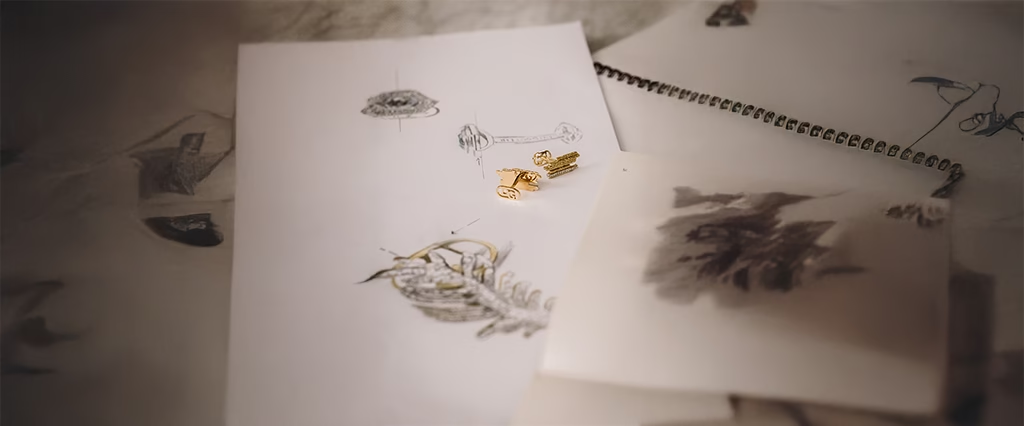
The 2026 Vision: A Decade of Defying the Ephemeral
As the brand approaches its tenth anniversary in 2026, David Gotlib is preparing to lift the curtain on his sanctuary. For years, the magic of his creations has been somewhat shrouded in mystery, known only to the artisans and the final wearers. Now, he is ready to open his doors—literally.
Gotlib plans to expand the concept of his atelier in Antwerp, the diamond capital of the world. This is not merely a retail space; it is a laboratory of luxury. He wants his clients to step inside the process, to breathe in the scent of the polishing wheels, and to witness the microscopic precision required to set a diamond into 18k gold.
“2026 is about deepening the brand’s voice and expanding the world it inhabits on an international level,” says Gotlib, reflecting on the journey ahead. “I’m also opening up the atelier. I want people to experience the pieces the way they’re meant to be experienced—held, felt, seen during their creation.”
This move toward transparency is a radical act in an industry often defined by smoke and mirrors. By inviting collectors and industry peers to gather, share ideas, and witness the craft, Gotlib is transforming his workspace into a cultural hub for the diamond trade. It is an invitation to slow down and appreciate the sheer engineering that goes into objects often dismissed as mere accessories.
The Philosophy of “Earned Heirlooms”
In a world of fast fashion and disposable luxury, Gotlib’s philosophy feels almost radical. He is singularly focused on creating objects that are “worthy of keeping for generations.” This isn’t just marketing speak; it is a rejection of the temporary.
“My philosophy is that jewelry should feel inevitable, like it always existed, and you simply discovered it,” Gotlib explains. “I’m not drawn to trends or to ornamentation without purpose. I’m interested in permanence, in the quiet power of form, in the way a piece becomes part of someone’s personal mythology.”
Defining the Modern Heirloom
Gotlib frequently speaks about the concept of the heirloom, a word that often carries the dust of the past. To him, however, an heirloom is an active, living object. It is not something that sits in a safe; it is something that participates in life.
“Heirlooms aren’t declared; they’re earned,” he adds, offering a profound insight into his design process. “They become heirlooms because someone reaches for them again and again, because they witness milestones, because they’re chosen with intention.”
This distinction is crucial. You cannot buy “vintage” off a shelf; you can only buy quality that survives long enough to become vintage. Gotlib’s refusal to alter his aesthetic based on the whims of celebrity influencers—such as the recent surge in antique diamond popularity driven by pop culture—demonstrates his commitment to his own artistic compass.

The Genesis Story: A Grandfather’s Legacy
To understand why David Gotlib is so obsessed with the permanence of cufflinks, one must look back to the moment the brand was spiritually conceived. It wasn’t in a boardroom or a design school, but at a family celebration.
Gotlib was inspired to start his jewelry label by a specific pair of cufflinks—an heirloom set that his grandfather had worn regularly for more than three decades. These weren’t just decorative items; they were a part of the man. Upon the occasion of Gotlib’s eldest son’s bar mitzvah, his grandmother passed these cufflinks down to him. The emotional weight of that transfer changed the trajectory of his life.
The Patina of a Life Lived
When Gotlib held his grandfather’s cufflinks, he didn’t just see gold and metal; he saw a biography written in scratches and softened edges.
“The cufflinks were deceptively simple: clean geometry, a quiet sense of proportion, and a weight that felt intentional in the hand,” Gotlib recalls. “They were made decades before I ever saw them, but they carried the fingerprints of the person who wore them. Tiny scratches. Softened edges. The patina of a life lived.”
This realization was the spark. He understood that the true value of jewelry is not in the carat weight or the market price of gold, but in its capacity to act as a vessel for memory.
“What struck me wasn’t their monetary value but their emotional gravity,” he says. “They were proof that an object can outlive its owner and still hold their presence. That realization changed everything for me. It made me want to create pieces that weren’t just beautiful in the moment, but meaningful across generations.”
Architectural Rigor Meets Chromatic Play
As Gotlib looks toward the new collections releasing in 2026, the evolution of his design language is evident. His early work was deeply rooted in his background as a diamantaire—obsessed with light, structure, and the “Four Cs.” The pieces were studies in line, symmetry, engineering, and discipline. He needed to master the rules of structure before he could earn the right to break them.
Now, confident in his structural mastery, he is allowing himself to play.
The Astor and Metropole Collections
The recent additions of the Astor and Metropole styles showcase this balance. While details remain guarded until the full 2026 unveil, the names themselves evoke a sense of place and history. The Metropole suggests the grid and verticality of the city—perhaps the skyline of New York or the historic density of Antwerp—translated into gold. These pieces are likely characterized by strong, masculine lines and an architectural integrity that mirrors the skyscrapers they are named after.
The Astor, meanwhile, hints at the Gilded Age—a nod to old-world sophistication, Art Deco geometries, and the timeless elegance of the tuxedo era. These are cufflinks for the man who appreciates the “rigor of form.”
Chroma and Chameleon Red: The Intuition of Color
If his early work was about discipline, his newer ventures into color are about emotion. The Chroma collection marked a significant departure, introducing vibrant colored gemstones into his previously monochromatic world of diamonds and gold.
Gotlib highlights the Chameleon Red cufflinks as a prime example of this new direction. These pieces feature rhodolite center stones, a gem known for its complex personality.
“He notes that on the Chameleon Red cufflinks, which are one of his favorite sets, the color of the rhodolite center stones changes subtly as the light shifts—so even cufflinks someone might wear for years can still surprise them,” the brand notes.
This is where the engineering meets the poetry. The stone reacts to its environment, changing from a deep, brooding red to a vibrant violet depending on the time of day. It is a metaphor for the wearer himself—constant, yet ever-changing.
“Instead of controlling every variable, I allow intuition to guide me. The palette becomes a kind of emotional vocabulary,” Gotlib explains. “The precision is still there in the architecture of the pieces, but the color introduces movement, spontaneity, and a sense of play.”

The Specialist’s Code: Why Only Cufflinks?
In an era where luxury brands try to be everything to everyone—selling perfumes, handbags, watches, and shoes—David Gotlib’s restraint is remarkable. He makes cufflinks. That is it.
This specialization allows for a depth of quality that generalist brands cannot match. Every millimeter of a David Gotlib cufflink is considered. The toggle mechanism is engineered for a satisfying “click.” The weight is calibrated to ensure the cuff hangs perfectly. He uses only the finest materials: solid 18k gold (never plated) and natural, untreated diamonds.
By focusing on this singular object, Gotlib elevates the cufflink from a functional fastener to a piece of wearable art. He understands that for many men, the cufflink is the only piece of jewelry they will wear besides a wedding band or a watch. It is a signifier of taste, a conversation starter, and, as he hopes, a future heirloom.
Conclusion: A Future Built on the Past
As 2026 approaches, David Gotlib is not looking to reinvent the wheel; he is looking to perfect it. By opening his atelier and deepening his commitment to “earned heirlooms,” he is betting that there will always be a place in the world for slow luxury.
In a fast-paced digital age, Gotlib offers something reassuringly analog: a heavy piece of gold, warmed by the skin, carrying the stories of the past into the future. Whether it is the shifting light of a rhodolite stone or the sharp geometry of an Art Deco diamond setting, his work reminds us that while trends may scream for attention, true style whispers—and it lasts forever.