


Trump Unleashes Economic Shockwave: Announces Staggering 50% Tariff on Indian Imports Over Russian Oil Dispute
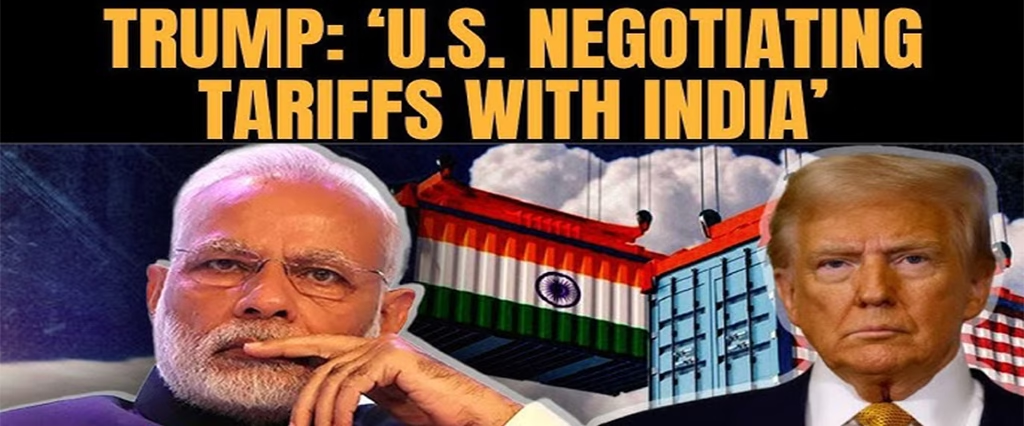
In a move that sent tremors through the corridors of international trade and diplomacy, President Donald Trump today announced a dramatic escalation of economic pressure on India. Through a sharply worded executive order, the White House declared its intention to levy an additional 25% tariff on all goods imported from the South Asian nation, with the new measures set to take effect on August 27th. This punitive action comes on top of a previously scheduled tariff hike, effectively creating a crippling 50% duty on Indian products entering the United States.
The decision marks one of the most aggressive trade actions taken by the Trump administration, placing the U.S.-India economic relationship in uncharted and perilous territory. The justification, as articulated by the President himself, centers on India’s continued procurement of crude oil from the Russian Federation, a practice the White House has condemned as providing financial lifeblood to Moscow’s ongoing war efforts. This move transforms a complex geopolitical issue into a direct and costly trade conflict, with profound implications for global supply chains, international alliances, and the economic stability of key industries on both sides of the Pacific.
The Anatomy of a Tariff Assault
The tariff structure outlined in the executive order is designed for maximum impact. The United States had already signaled its displeasure with Indian trade practices, having planned to increase an existing 10% tariff to a more substantial 25%. Today’s announcement serves as a powerful accelerant, stacking another 25% on top of that increase.
A 50% Wall Against Indian Goods
Beginning August 27th, U.S. importers will face a daunting 50% duty on Indian merchandise. This rate is not merely a tax; it is a formidable trade barrier designed to make Indian goods prohibitively expensive for American businesses and consumers. For many products, a tariff of this magnitude effectively erases any competitive price advantage, forcing importers to seek alternative suppliers in other countries or pass on a massive price hike to customers. This positions India under one of the highest tariff regimes imposed by the United States on any major trading partner, signaling a severe and deliberate chill in relations.
Trump’s Rationale: “Fueling the War Machine”
President Trump left no ambiguity about his motivations. In a candid interview with CNBC on Tuesday, he directly linked the tariffs to India’s energy policy. “India is buying Russian oil, they’re fueling the war machine,” Trump stated unequivocally. “If they’re going to do that, then I’m not going to be happy.”
This statement frames the tariff not as a tool of economic protectionism, but as a geopolitical weapon. The White House’s position is that by purchasing discounted Russian crude, India is undermining the international sanctions coalition led by the U.S. and its G7 partners, which aims to cripple Russia’s ability to finance its military operations. From Washington’s perspective, India’s actions are a direct contravention of the collective effort to isolate Moscow, and the tariffs are the consequence of that perceived defiance.
India’s Defiant Response: “Unfair, Unjustified, and Unreasonable”
New Delhi’s reaction was swift and resolute. India’s Ministry of External Affairs issued a powerful statement defending its position, casting the American tariffs as a punitive and hypocritical act. The ministry underscored that its primary responsibility is to its own citizens, not to the foreign policy objectives of another nation.
“Our energy imports are based on market factors and done with the overall objective of ensuring the energy security of the 1.4 billion people of India,” the statement read. For a rapidly developing economy with immense energy needs, the availability of discounted Russian oil represents a critical economic lifeline, helping to manage inflation and power industrial growth.
The ministry further condemned the U.S. action, pointing out the double standard at play. “It is therefore extremely unfortunate that the U.S. should choose to impose additional tariffs on India for actions that several other countries are also taking in their own national interest,” the statement continued. “We reiterate that these actions are unfair, unjustified, and unreasonable. India will take all actions necessary to protect its national interests.” This defiant tone suggests that India is unlikely to capitulate and may be preparing retaliatory measures, setting the stage for a protracted and damaging trade war.
The Economic Fallout: Which Industries Will Bleed?
The 50% tariff is a blunt instrument that will cause widespread economic pain, but certain sectors are uniquely vulnerable due to their heavy reliance on the U.S. market. Financial analysts are already sounding the alarm about the potential for severe disruption.
Gems and Jewelry: A Glittering Industry in Peril
According to a client note from Tanvee Gupta Jain, a respected economist at UBS, the gems and jewelry sector stands to be one of the most immediate and significant casualties. As reported by CNBC, this industry is a cornerstone of India’s export economy to the United States. Indian artisans are renowned for their skill in cutting and polishing diamonds and crafting intricate gold and silver jewelry, much of which is destined for American retailers.
A 50% tariff would decimate this trade. U.S. jewelry chains would be forced to find new sources for their products, potentially shifting business to countries like Thailand, Vietnam, or China. For the millions of skilled workers in Indian cities like Surat and Jaipur, this could mean widespread job losses and economic hardship. American consumers, in turn, would face significantly higher prices for engagement rings, necklaces, and other luxury items.
A Ripple Effect Across Multiple Sectors
While gems and jewelry may be in the direct line of fire, the impact will be felt across a broad spectrum of industries. India’s top exports to the U.S. include a diverse range of goods:
- Pharmaceuticals: India is a major supplier of generic drugs to the U.S. market. While some essential medicines may receive exemptions, many other pharmaceutical products could be hit, potentially raising healthcare costs for Americans.
- Textiles and Apparel: From clothing to home furnishings, Indian textiles are a staple for many U.S. brands. Tariffs would force these brands to raise prices or move production elsewhere.
- Machinery and Automotive Parts: India’s manufacturing sector has been a growing supplier to U.S. industries. The tariffs threaten to disrupt these complex supply chains, impacting American factories.
A Wider Diplomatic Chessboard
The U.S.-India tariff clash is not occurring in isolation. It is part of a broader pattern of the Trump administration’s use of aggressive trade tactics as a primary tool of foreign policy. This was further evidenced by a related development in Washington this week.
Swiss President Karin Keller-Sutter made an urgent trip to the U.S. capital for high-stakes negotiations. Her mission: to head off a planned 39% tariff on Swiss imports, which was scheduled to go into effect imminently. Following a meeting with the U.S. Secretary of State, identified in reports as Mario Rubio, Keller-Sutter cautiously told reporters she’d had a “very good meeting.” The situation highlights that multiple U.S. trading partners are currently under threat of similar punitive measures, creating an atmosphere of global economic uncertainty. The simultaneous pressure on both India and Switzerland demonstrates a consistent “America First” strategy that prioritizes the use of economic leverage to achieve its geopolitical aims, even at the risk of alienating key partners.
