


From Diamonds to Diapers: Why the Founder of Jewelers Helping Jewelers is Championing Immigrant Rights
In the glittering, high-stakes world of the diamond trade, Aleah Arundale has long been a household name. Known for her vibrant personality, flashy trade show attire, and an unapologetic penchant for asking the toughest questions in the room, the Olympian Diamonds salesperson is anything but a wallflower. She is the force of nature behind “Jewelers Helping Jewelers” (JHJ), a Facebook behemoth with 35,000 members that functions as the industry’s digital town square. But recently, Arundale’s focus has shifted from the brilliance of gemstones to the resilience of the human spirit.
While she continues to dominate the jewelry scene, Arundale is increasingly making headlines for a different reason: her tireless advocacy for refugees and immigrants in Chicago. Her transition from industry influencer to humanitarian activist has caught the attention of major outlets like The Washington Post, The Free Press, and NBC Chicago. While the media often frames her work through a political lens, Arundale insists her motivation is much simpler—it is about community, a lesson she learned through the very jewelry group she founded.
The Genesis of Jewelers Helping Jewelers (JHJ)
To understand Aleah Arundale’s current mission, one must first look at the success of JHJ. When she started the Facebook group, it was intended to be a resource for professionals to trade tips, sell inventory, and support one another in a competitive field. Today, it averages 350 posts a day, serving as a lifeline for jewelers across the globe.
Arundale notes that JHJ taught her a fundamental truth: community is built on the act of helping others without expecting an immediate return. “JHJ made me realize how great it is when you help others and can build a community,” she explains. That same philosophy—that a rising tide lifts all boats—became the foundation for her response when a humanitarian crisis landed literally on her doorstep.
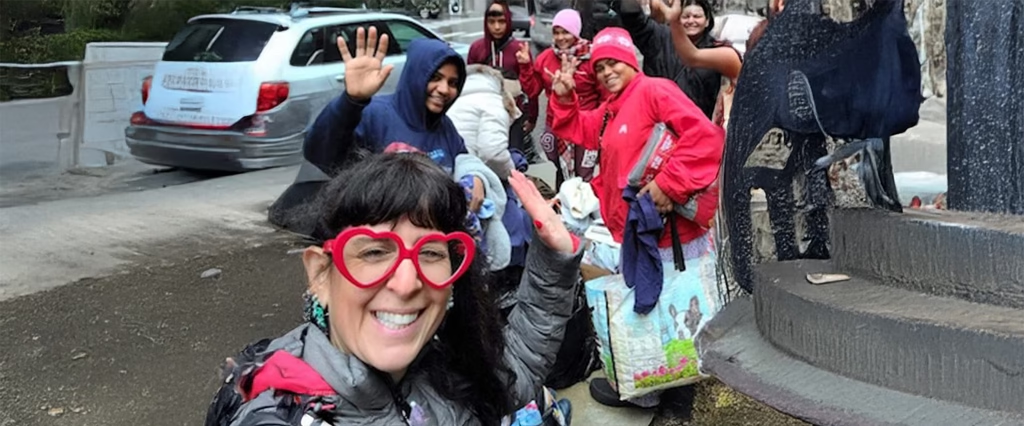
A Turning Point in Chicago: When the Crisis Arrived at Her Doorstep
The shift in Arundale’s life began in 2022. As political tensions regarding border security escalated, Texas Governor Greg Abbott began busing thousands of newly arrived immigrants to northern “sanctuary cities.” One of those cities was Chicago, where Arundale lives and works.
The reality of the situation hit home when she saw buses unloading families in her own neighborhood—specifically, right in front of her daughter’s dance class. “They were dropping these people off in front of my daughter’s dance class,” she recalls. “There are hundreds of people—they have no shoes, no coats—and they are just being left on the sidewalk to wander around in front of the Dollar Tree. I couldn’t figure out what was happening.”
Rather than turning away or complaining to local authorities, Arundale did what she does best: she asked questions. She began handing out handwritten notes in Spanish to the new arrivals. Her message was simple: “Hi, I’m a local mom. What the hell’s going on? I don’t trust the news. I want to hear it from you.”
Hearing the Stories of the Displaced
The stories she heard were a far cry from the political soundbites dominating the airwaves. Most of the people she met were part of a federal program providing temporary asylum to those fleeing political persecution, particularly from Venezuela under the regime of Nicolás Maduro.
Arundale listened to accounts of survival that would haunt anyone. “I started hearing these horrific stories about people being murdered,” she says. She tells the story of a woman who fled after one of her three sons was killed by the government, with the threat that the other two would be next. “She ran for her life, just like any of us would. These people didn’t come here for convenience. They came here for safety.”
She quickly realized that these were not the “invaders” often depicted in the media. They were doctors, architects, and police officers—skilled professionals who had been forced to leave everything behind.
Turning a Living Room into a Sanctuary: The Logistics of Compassion
Arundale’s response was immediate and practical. She asked the refugees what they needed most. The answers were heartbreakingly mundane: winter coats, gloves, and sturdy shoes to survive the brutal Chicago winter.
She began soliciting donations from her local network and the jewelry community. Soon, her home was transformed into a makeshift refugee center. Her living room became a hub where families could find warm clothing and basic necessities. But as the numbers grew, so did her involvement.
“I helped people with their work permits. I helped get their kids registered for school. We did a wedding, a couple of funerals,” she says. Beyond immediate relief, Arundale worked to provide long-term stability, helping five families secure permanent housing. She effectively created a one-woman NGO, providing every resource a “new American” might need to start their journey. This spirit eventually led her to create another Facebook community, “Immigrants Helping Immigrants,” mirroring the peer-to-peer support model of her jewelry group.
Navigating the Changing Political Landscape of 2025
The situation for Arundale’s new friends took a dark turn in March 2025. Following a change in federal policy, the temporary protection status for approximately 500,000 refugees was repealed. Almost overnight, the people Arundale had spent years helping were reclassified as undocumented, making them targets for deportation.
For Arundale, this felt like a betrayal of the American promise. “America changed the game,” she asserts. “We told these people, ‘Come on in.’ Whether you agree with the last administration or not, we made a promise to them, and we broke it.”
She witnessed firsthand the integration of these families into the American fabric. In less than a year, many had learned English, secured jobs, and were contributing to their local economies. “I was watching the American Dream happen before my eyes… and then America decided to f— it up.”
Facing the Human Cost of ICE Enforcement
As Immigration and Customs Enforcement (ICE) ramped up its efforts, Arundale’s role shifted from community builder to crisis manager. The calls she receives now are much more dire. Instead of requests for strollers or diapers, she hears from wives whose husbands have been deported and mothers in detention centers whose children have been left alone.
The violence of the enforcement measures has been particularly jarring for her. She describes scenes where 20 of her friends were taken in a single day, including an 80-year-old woman who had sold tamales in the neighborhood for two decades. In another instance, a nanny was taken from a park, leaving the children she was watching stranded and alone.
“I don’t see how anyone can support tearing apart families,” Arundale says. “Imagine your wife or kids were taken and you didn’t know where they were. This community is terrified.”
The Paradox of the Conservative Humanitarian
What makes Arundale’s stance particularly notable is her own political background. She identifies as a conservative and has openly stated that she voted for Donald Trump. She believes in border security and the deportation of criminals, but what she sees on the ground is entirely different from the policy she expected.
“This whole immigration issue has become politicized, and it shouldn’t be,” she argues. She challenges her fellow conservatives to see the new arrivals as human beings rather than political pawns. She points to the ancestral history of most Americans—Irish, Italian, German—reminding people that almost everyone in the U.S. comes from an immigrant background. “It’s like building a bridge, and then burning it down.”
The Personal Cost of Speaking Out
Standing up for a marginalized group in a polarized climate is not without its risks. Arundale’s Facebook post detailing her experiences went viral with 1.7 million views, but the exposure has been a double-edged sword. She believes she has lost customers because of her outspoken views, and she has even been warned by legal professionals that she is putting herself in potential legal or physical danger.
However, the “character” who isn’t afraid to ask questions at trade shows isn’t backing down now. “I am not afraid. I don’t want to live that way,” she says firmly. “I don’t want to not deliver a heater because something might happen. We have too many cowards today.”
A Call to Action for the Jewelry Industry
Despite the heavy subject matter, Arundale remains focused on the positive impact of local action. She believes that jewelers, as pillars of their communities, are uniquely positioned to help. Her advice is simple: reach out to local Hispanic centers or churches and ask what families need.
“Jewelers can even gather supplies,” she suggests. “Just like I made my house into a drop-off center, they can do that with their store. That’ll be good for your neighborhood, and good for your business.”
For Arundale, the act of helping is not just a moral obligation; it is a source of immense personal joy. She describes the “rush” of delivering a heater to a freezing family and receiving a hug in return. “Helping people is what my entire brand is built on… Everyone has people in their own backyard who need help. That’s the only way the world is going to get better.”
The Ultimate Reward
Aleah Arundale’s story is a powerful reminder that community doesn’t stop at the doors of a jewelry shop or the borders of an industry. By applying the same principles of networking and mutual aid that made “Jewelers Helping Jewelers” a success, she has provided a lifeline to hundreds of people in their darkest hours. While the political debates rage on, Arundale continues to drive through the streets of Chicago, delivering heaters, strollers, and—most importantly—hope to those who the rest of the world has chosen to forget.