


India Secures Leadership of Kimberley Process for 2026, Ending Global Diplomatic Standoff
New Delhi — In a landmark decision that resolves a prolonged period of uncertainty for the global diamond trade, India has been unanimously selected to chair the Kimberley Process (KP) for the year 2026. The announcement, finalized just days before Christmas 2025, marks a pivotal moment for the international certification scheme, bringing an end to a two-year diplomatic deadlock that had threatened to leave the organization’s top leadership position vacant.
As the world’s largest center for diamond manufacturing, India’s ascension to the chair offers a stabilizing force for the 86-country body. This development not only secures the organization’s immediate future but also sets the stage for a new era of leadership, with the West African nation of Ghana confirmed to succeed India in 2027.
A Unanimous Decision After a Turbulent Year
The decision to appoint India was reached via a written procedure initiated in early December 2025, following the inability of member nations to reach a consensus during the annual Plenary meeting in Dubai earlier in November. The breakthrough came just in time, allowing India to assume the role of Vice Chair for the final week of 2025, specifically from December 25, before formally taking over the Chairmanship on January 1, 2026.
This seamless, albeit last-minute, transition is critical for the Kimberley Process Certification Scheme (KPCS), which requires absolute consensus among its participants to function. The selection was greeted with relief and optimism by industry leaders.
Shri Piyush Goyal, India’s Union Minister of Commerce & Industry, welcomed the development, stating that India’s selection “reflects global trust in the country’s commitment to fostering integrity and transparency in international trade.” For India, this is a familiar responsibility; 2026 will mark the third time the country has helmed the KP, having previously led the initiative in 2008 and 2019.
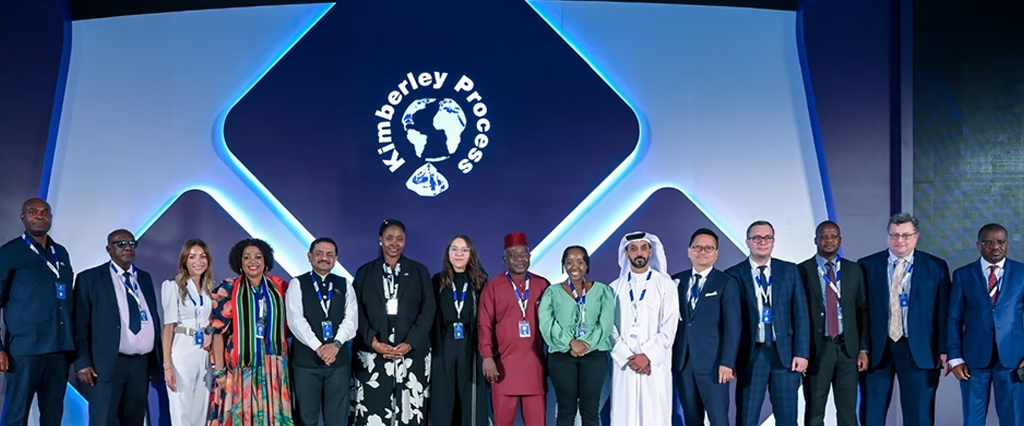
Anatomy of the Deadlock: How the Crisis Unfolded
To understand the significance of India’s appointment, one must look at the unprecedented leadership vacuum that plagued the Kimberley Process throughout 2024 and 2025. The organization, tasked with preventing “conflict diamonds” from entering the mainstream rough diamond market, found itself paralyzed by geopolitical rifts that mirrored the broader tensions on the world stage.
The UAE’s Extended Mandate
The cracks in the consensus model appeared when the KP failed to agree on a Vice Chair for 2024. Under normal protocols, the Vice Chair automatically ascends to the Chair position the following year. With no successor in place, the United Arab Emirates (UAE), which chaired the body in 2024, was forced to continue leading the organization for a second consecutive year in 2025 as a “Custodian Chair.” This was an unusual arrangement, necessitated by the lack of an alternative, and highlighted the deep divisions within the group.
The Withdrawal of Thailand and Geopolitical Tensions
Hopes were initially pinned on Thailand, which had been selected to serve as the Vice Chair for 2025. However, in a surprising turn of events, Thailand withdrew from the post before the year concluded, leaving the KP with no obvious successor for 2026.
The search for a replacement became a diplomatic minefield. Several nations attempted to bid for the leadership but were blocked by rival factions:
- Belarus put forward a bid but was swiftly blocked by Western nations due to its close political and military ties with Russia amid the ongoing conflict in Ukraine.
- Qatar expressed interest but faced strong opposition from Israel.
- Zimbabwe reportedly volunteered but withdrew its candidacy at the last minute during the Dubai Plenary.
This series of rejections and withdrawals created a “perfect storm,” threatening to leave the KP rudderless until India stepped in to bridge the divide.
Ghana’s Historic Rise to Leadership
While India steers the ship in 2026, the recent negotiations also clarified the long-term succession plan. Ghana has been officially appointed as the Vice Chair for 2026 and will ascend to the Chairmanship in 2027.
This is a historic milestone for the Kimberley Process. Ghana will become the first West African nation to lead the organization. The appointment of Ghana is seen as a victory for African diamond-producing nations, who have long argued for a greater voice in the regulation of their natural resources. It also ensures a smooth transition of power following India’s term, providing the stability the industry desperately craves.
India’s Strategic Vision for the Diamond World
India’s leadership comes at a time when the global diamond industry is navigating its most complex challenges in decades. As the hub where nine out of ten diamonds in the world are cut and polished, India holds a unique position of influence. The city of Surat and the Bharat Diamond Bourse in Mumbai are the engines of the global trade, processing rough stones from mines in Africa, Russia, and Canada before they reach retail markets in the US and China.
A Legacy of Responsibility
The Gem & Jewellery Export Promotion Council (GJEPC) of India has strongly backed the government’s new role. Kirit Bhansali, Chairman of the GJEPC, noted that the country would focus on strengthening the KP’s efficiency. “India’s selection reflects the international community’s trust in our principled and inclusive approach,” Bhansali said.
During its previous terms in 2008 and 2019, India was credited with bridging the gap between mining countries and manufacturing centers. For 2026, the agenda is expected to be even more ambitious.
Key Priorities: Digitization and Traceability
The Indian Commerce Ministry has outlined three core priorities for its chairmanship:
- Strengthening Governance: Enhancing the peer review mechanism to ensure all member countries are strictly adhering to KP standards.
- Digital Transformation: Moving away from paper certificates to a blockchain-secured digital certification system. This is crucial for preventing fraud and increasing the speed of trade.
- Traceability: This is the most pressing issue. With G7 nations demanding proof of origin to enforce sanctions on Russian diamonds, India will likely push for a unified KP-backed traceability solution that satisfies Western demands without alienating other partners.
The Existential Crisis Facing the Kimberley Process
India assumes the chair during what many experts call an existential crisis for the Kimberley Process. Established in 2003 to stop rebel groups from using diamond sales to finance wars against legitimate governments, the KP is now struggling to remain relevant in a world where the definition of “conflict” has evolved.
The Debate Over “Conflict Diamonds”
For years, Western nations and civil society coalitions (like the KP Civil Society Coalition) have demanded that the KP expand its definition of “conflict diamonds.” Currently, the definition only covers gemstones used by rebel movements to fight governments. It does not cover diamonds mined by state actors involved in human rights abuses or cross-border conflicts.
This narrow definition has allowed Russian diamonds to continue receiving KP certification despite the war in Ukraine, frustrating G7 nations. Attempts to expand this definition have been consistently blocked by Russia, China, and several African nations who view it as political interference. India will face the difficult task of mediating this intense debate, trying to find a consensus where none has existed for a decade.
The Challenge of G7 Sanctions
Perhaps the biggest threat to the KP’s authority is the rise of parallel certification schemes. The G7 countries (including the US, Canada, and EU members) have begun implementing their own strict import bans on Russian diamonds, requiring advanced traceability evidence that bypasses the KP’s traditional “mixed origin” allowances.
If the G7 successfully creates its own dominant verification ecosystem, the Kimberley Process risks becoming obsolete. As the Chair, India—which relies heavily on rough supply from Russia but sells the majority of its polished product to the G7—must navigate this geopolitical tightrope. The goal will be to prove that the Kimberley Process can evolve fast enough to remain the primary guarantor of trust in the global diamond supply chain.
Conclusion
The unanimous selection of India as the 2026 Chair is more than just a procedural appointment; it is a critical intervention that saves the Kimberley Process from institutional paralysis. By stepping in after the withdrawal of Thailand and the deadlock surrounding other candidates, India has bought the organization valuable time.
With Ghana waiting in the wings for 2027, the immediate leadership crisis is resolved. However, the deeper challenges—defining conflict in the modern age, managing geopolitical sanctions, and modernizing the supply chain—remain. The world will be watching closely to see if New Delhi can use its immense industry leverage to unite a fractured global body and restore faith in the sparkle of natural diamonds.