


Pandora Accelerates Leadership Transition: Berta de Pablos-Barbier to Take Helm on January 1
In a significant move that signals confidence in its corporate governance and strategic direction, Pandora A/S has announced that its incoming CEO, Berta de Pablos-Barbier, will assume the top leadership role on January 1, 2026. This date is two months ahead of the schedule originally communicated to shareholders and the market in September.
The accelerated timeline marks the beginning of a new era for the world’s largest mass-market jewelry brand. While the company originally planned for the leadership handover to coincide with the Annual General Meeting in March 2026, the Board of Directors has determined that the transition process has been effective enough to warrant an earlier start. This decision not only highlights the internal stability of the Danish jeweler but also places a renewed focus on its aggressive “full jewelry brand” strategy amidst a volatile global luxury market.
The Accelerated Timeline: From March to January
The announcement, released today by the Copenhagen-based company, confirms that current Chief Marketing Officer Berta de Pablos-Barbier will succeed Alexander Lacik effectively on New Year’s Day.
According to a statement from Board Chair Peter Ruzicka, the decision to fast-track the appointment was driven by an “exceptionally smooth” transition period. Corporate successions in the luxury sector are often fraught with friction or uncertainty, but Pandora appears to have executed a seamless transfer of knowledge and strategic responsibility.
Furthermore, the board cited the readiness of the incoming Chief Marketing Officer as a key enabler for this move. With the marketing leadership gap filled earlier than anticipated, Pablos-Barbier is free to step into the CEO role without retaining dual responsibilities. This allows the company to hit the ground running at the start of the fiscal year, rather than waiting for the end of the first quarter.
Who is Berta de Pablos-Barbier?
Berta de Pablos-Barbier is not a typical jewelry executive; her résumé represents a hybrid of high-end luxury stewardship and Fast-Moving Consumer Goods (FMCG) discipline. This unique combination is viewed by analysts as the ideal skillset for Pandora, a brand that sits at the intersection of affordable accessibility and aspirational luxury.
Before joining Pandora as Chief Marketing Officer in November 2024, Pablos-Barbier built a formidable reputation across several major global industries. She previously served as the President and CEO of LVMH’s prestigious champagne division, managing iconic houses such as Moët & Chandon, Dom Pérignon, and Mercier. Her tenure at LVMH was marked by a focus on elevating brand equity while navigating supply constraints—experience that is directly applicable to the jewelry industry’s current challenges with commodities.
Prior to her time in the luxury spirits sector, she held the position of Chief Growth Officer at Mars Wrigley, giving her deep insight into mass-market consumer psychology and global supply chains. Additionally, her experience includes a tenure as CMO of the fashion brand Lacoste and a role as Vice President of Marketing and Communications for the Kering-owned high-jewelry house Boucheron.
This blend of selling chocolates, polo shirts, high-jewelry, and champagne provides Pablos-Barbier with a rare panoramic view of the consumer landscape. Her mandate at Pandora is clear: to maintain the operational efficiency established by her predecessor while injecting a new level of brand desirability that transcends the company’s famous charm bracelets.
A Vision for the Future: Navigating Turbulence
In her statement regarding the early appointment, Pablos-Barbier acknowledged both the opportunities and the threats facing the company in 2026.
“My immediate focus will be to navigate the current market turbulence while gearing up to leverage our untapped opportunities as a full jewelry brand and drive long-term growth,” she said.
The “market turbulence” likely refers to the macroeconomic headwinds that have battered the luxury sector throughout 2025. Rising prices for raw materials—specifically silver and gold—have squeezed margins across the industry. Furthermore, consumer spending in key markets like China and parts of Europe has been inconsistent. However, Pandora has largely bucked the negative trends affecting competitors like Signet Jewelers and even luxury giants like Kering, thanks to its specific market positioning.
Pablos-Barbier’s reference to the “untapped opportunities as a full jewelry brand” signals a doubling down on the company’s strategic pivot. Pandora is actively trying to change consumer perception, moving from being seen solely as a destination for collectable charms to a serious jeweler offering rings, necklaces, pearls, and lab-grown diamonds.
The Legacy of Alexander Lacik and “Project Phoenix”
The early departure of Alexander Lacik from the CEO chair marks the conclusion of one of the retail industry’s most successful turnaround stories. When Lacik took the reins in 2019, Pandora was struggling with brand fatigue, declining same-store sales, and a lack of clear direction.
Lacik, a veteran of Reckitt Benckiser and Britax, implemented “Project Phoenix,” a strategy launched in 2021 designed to stabilize the core business and fund future growth. The results have been undeniable. Under his leadership, Pandora has reported robust growth even when the broader jewelry market contracted.
Board Chair Peter Ruzicka praised Lacik’s tenure, noting that since his arrival, Pandora’s revenue has grown by 45%, and total shareholder return has exceeded 200%. Lacik successfully modernized the company’s manufacturing capabilities in Thailand and oversaw the controversial but ultimately successful entry into the lab-grown diamond market—a move that democratized access to diamond jewelry and opened a new revenue stream for the company in North America, Europe, and Australia.
Lacik will not be leaving the company immediately, however. To ensure that the “smooth transition” continues, he will remain with Pandora as a special adviser to the board and the executive leadership team until the shareholders’ annual general meeting on March 11, 2026. This advisory period will likely focus on long-term capital allocation projects and ensuring key stakeholder relationships are handed over to Pablos-Barbier without disruption.
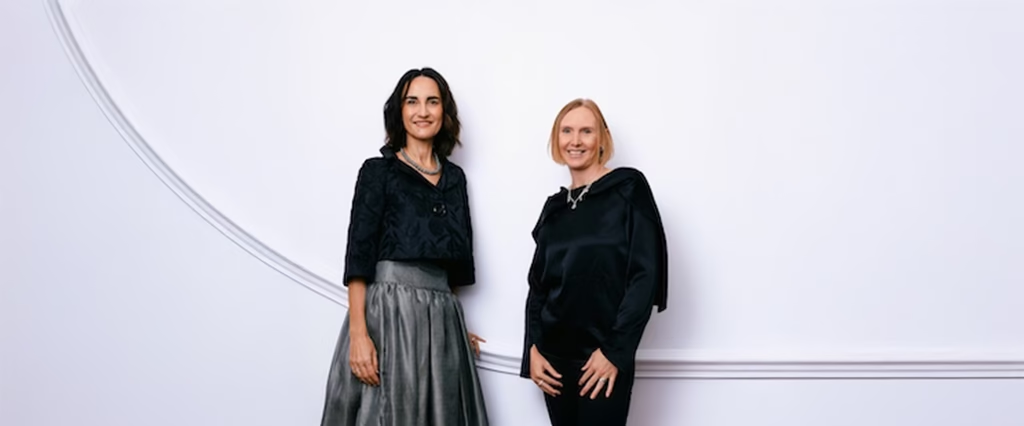
Jennie Farmer: The New Chief Marketing Officer
A critical component of this accelerated transition is the internal promotion of Jennie Farmer to the role of Chief Marketing Officer, effective January 1, 2026.
Farmer is currently Pandora’s Senior Vice President of Brand Experience and Channels, a role she has held since joining the company in January 2025. Her rapid ascent to the C-suite after just one year at the company speaks volumes about her impact on the brand’s recent “BE LOVE” global campaigns and her ability to execute complex marketing strategies.
A Veteran of Luxury and Diamonds
Jennie Farmer’s background makes her uniquely qualified to support the company’s push into higher-value categories. Her résumé spans 25 years working for some of the world’s most recognizable luxury and consumer brands.
Most notably, Farmer served as the Global Marketing Director and Product Director for De Beers Jewellers from October 2019 to November 2020. Her experience at De Beers, the world’s leading diamond company, will be invaluable as Pandora seeks to gain credibility in the diamond market. While Pandora sells lab-grown diamonds and De Beers has historically championed natural stones, Farmer understands the emotional storytelling required to sell high-value stones—a different skillset than selling volume-based silver charms.
In addition to her time at De Beers, Farmer has held leadership roles at LVMH Estates & Wines, The Office Group, and OKA. This diversity of experience ensures she understands both the product-centric requirements of jewelry and the experiential demands of modern retail.
Strategic Implications for Pandora in 2026
As 2026 approaches, the new leadership team of Pablos-Barbier and Farmer faces a distinct set of challenges and opportunities. The “Phoenix” strategy is now entering a new phase, often referred to internally as “Phoenix Chapter 2.”
The primary goal is the “Full Jewelry Brand” evolution. Currently, charms and bracelets still account for nearly three-quarters of Pandora’s sales. While this core business is healthy, the company sees massive potential in the “Fuel with More” categories—specifically earrings, necklaces, and rings. The success of the “Pandora Essence” collection and the rollout of lab-grown diamonds are proof points that the Pandora customer is willing to spend more for different aesthetics.
However, the “turbulence” mentioned by the incoming CEO is real. The price of silver, Pandora’s primary raw material, has seen significant volatility in late 2025. To maintain its “affordable luxury” price points without eroding margins, the company will need to rely on the operational efficiencies that Lacik put in place, while Pablos-Barbier and Farmer work to increase the brand’s desirability—allowing for potential price elasticity.
Furthermore, the company is in the midst of a massive retail overhaul, dubbed “Evoke 2.0,” which involves redesigning stores to facilitate better customer service and highlight the new, broader product assortment.
Conclusion
The decision to install Berta de Pablos-Barbier as CEO two months early is a testament to Pandora’s current strength. In an industry often plagued by sudden exits and leadership vacuums, Pandora has orchestrated a textbook succession plan.
By combining Pablos-Barbier’s brand-building expertise with Jennie Farmer’s deep luxury and diamond knowledge, and retaining Alexander Lacik’s operational wisdom as an advisor, Pandora is positioning itself to aggressively capture market share in 2026. As the company transitions from a turnaround story to a growth story, all eyes will be on whether this new leadership team can successfully convince the world that Pandora is, indeed, a full-scale jeweler.