


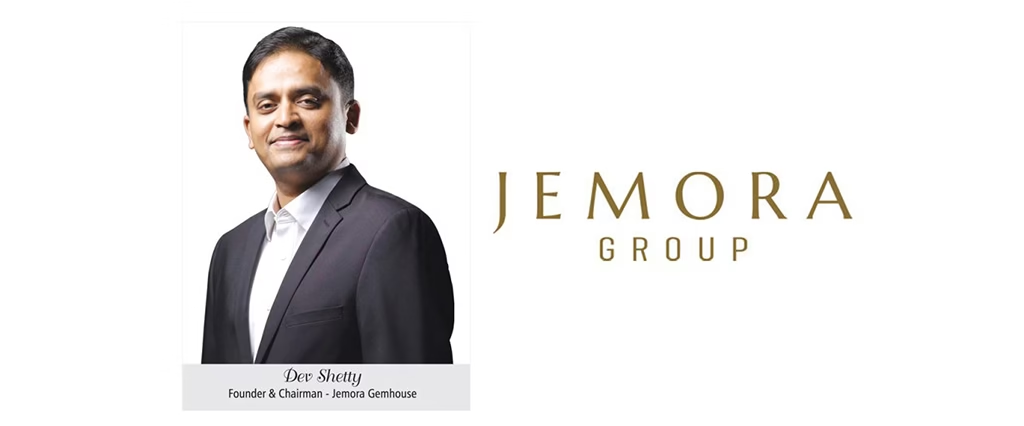
A Bold New Chapter: Dubai’s Jemora Group Acquires Lucapa Diamond in a Strategic Play for a High-Carat Future
In a move signaling strong confidence in the high-end natural diamond market, Dubai-based investment firm Jemora Group has officially acquired Lucapa Diamond Company, the embattled Australian miner that recently entered voluntary administration. The acquisition, executed through its mining and mineral investment subsidiary Gaston International, represents a calculated bet on turning around distressed yet fundamentally valuable assets in a challenging global market.
While the financial terms of the deal were not disclosed, the news has sent ripples through the industry. It marks a potential phoenix-like revival for Lucapa, a company renowned for its ownership of two significant diamond properties: the prolific, large-stone-producing Lulo mine in Angola and the high-potential, yet dormant, Merlin mine in Australia.
Leading this ambitious turnaround is Dev Shetty, a titan of the gemstone industry and the head of both Gaston International and its parent, Jemora Group. A well-respected veteran known for his transformative leadership at Gemfields and for founding Fura Gems, Shetty sees immense, untapped potential where others saw financial distress. In an exclusive comment, he laid out his vision, not as a speculative gamble, but as a strategic unlocking of value. He believes Lucapa’s assets, particularly the Lulo mine, possess an intrinsic resilience that can weather the current industry storms.
The Visionary Behind the Venture: Dev Shetty and the Jemora Strategy
To understand the significance of this acquisition, one must understand the track record of Dev Shetty. His career is a testament to his ability to identify and cultivate value in the complex world of precious minerals. During his tenure as Chief Operating Officer and Executive Director at Gemfields from 2009 to 2017, he was a pivotal figure in transforming the company into the world’s leading supplier of responsibly sourced colored gemstones. He oversaw the revitalization of the Kagem emerald mine in Zambia and the Montepuez ruby mine in Mozambique, turning them into globally significant sources and establishing a new benchmark for operational excellence and market transparency.
After Gemfields, Shetty founded Fura Gems, building a multi-asset colored gemstone mining company from the ground up and serving as its CEO until last year. His expertise lies not just in geology or mining logistics, but in understanding the entire value chain—from the mine to the market.
This acquisition is a cornerstone of the broader, ambitious strategy of the Jemora Group. Far from being a single-minded diamond play, the purchase of Lucapa is part of a calculated expansion into a diversified portfolio of natural resources. This is evidenced by another recent move from Gaston International: the purchase earlier this month of the Chacarilla copper mine in La Paz, Bolivia. This diversification into base metals highlights a long-term vision for building a robust, multi-commodity resource group. Furthermore, Jemora is already building its downstream capabilities with a new auction arm, Jemora Gemhouse, which successfully staged its inaugural sapphire sale in New York City this past March. This vertically integrated approach suggests a plan to control assets from extraction straight through to sale, capturing value at every step.

The Crown Jewel: Unlocking the Full Potential of Angola’s Lulo Mine
At the heart of Jemora’s new acquisition lies the Lulo Alluvial Mine in Angola, an asset that has consistently punched far above its weight. While the global diamond market faces headwinds from lab-grown competition and macroeconomic pressures, Shetty argues Lulo operates in a protected niche.
“Even in the current diamond environment, Lulo has always been shielded from the current turmoil, because of how small it is and how many specials [larger stones] it produces,” Shetty explains. “I believe there will always be a strong market for top diamonds.”
Home of the World’s Most Extraordinary Diamonds
Shetty’s confidence is well-founded. Lulo is not just any diamond mine; it is a treasure chest that has yielded some of the most significant diamonds discovered in the 21st century. Since beginning production in 2015, it has produced an astonishing 48 Type IIa diamonds weighing over 100 carats.
Type IIa diamonds are the most chemically pure and often the most valuable of all diamonds. They are virtually free of nitrogen impurities, resulting in exceptional transparency and brilliance. They represent less than 2% of all gem diamonds, and the world’s most famous stones, including the Cullinan and the Koh-i-Noor, are Type IIa.
Lulo’s honor roll includes the spectacular 170-carat “Lulo Rose,” one of the largest pink diamonds ever found, and the magnificent 404-carat “4th of February” stone, a flawless D-color diamond that sold for a reported $16 million. These “specials” are what give the mine its legendary status and its economic insulation.
The Turnaround Plan for Lulo
Despite these incredible discoveries, the mine has been underperforming its potential. Shetty points to a clear and actionable path for growth. He notes that currently, only one of Lulo’s three processing plants is operating at full capacity. This operational bottleneck has limited the mine’s output and revenue.
“I believe if the resource is planned properly, we can take the mine to the next level,” Shetty asserts. “It just needs one extra push, and that’s where we come in.”
The Jemora Group plans to inject the necessary capital and operational expertise to ramp up production across all three plants. This will involve optimizing the mining plan, improving processing efficiency, and ensuring a steady, increased flow of high-value alluvial gravels. By simply bringing the mine to its designed capacity, Jemora can significantly increase carat recovery and cash flow, financing further exploration and development on the Lulo concession.
Beyond Diamonds: Reviving the Untapped Promise of the Merlin Mine
While Lulo is the immediate prize, the acquisition also includes the Merlin property in Australia’s Northern Territory, an asset with a compelling, albeit complicated, history. The Merlin mine has previously produced some of Australia’s largest and highest-quality diamonds, but full-scale production has remained elusive.
Shetty and his team see a multi-layered opportunity at Merlin. The immediate plan is to revive the project, which was previously stalled. “We are going to look at the next phase of feasibility, which was stopped after the tariff regime came on,” he says. “Merlin still has a way to go as far as full-scale production.”
This new feasibility study will not only reassess the diamond resources but will also explore the site’s significant polymetallic potential. Shetty notes that early indications suggest Merlin may be rich in other valuable commodities. “Merlin may not just be rich in diamonds but it also might potentially yield lead, zinc, copper, and gold,” he stated. This multi-commodity potential aligns perfectly with Jemora’s diversified resource strategy, offering a hedge against the volatility of a single market and creating multiple potential revenue streams from a single asset.
The revival of Merlin could also be a significant development for Australia’s mining sector, potentially creating jobs and re-establishing a domestic source for high-value diamonds and critical minerals.
This strategic acquisition by the Jemora Group is more than a simple corporate buyout; it is a powerful statement about the enduring allure of the world’s finest natural treasures. Led by an industry visionary with a proven history of success, this new chapter for Lucapa Diamond Company is a contrarian bet that, in a world of fleeting trends, the market for rare, large, and exceptional natural diamonds will not only survive but thrive. It is a story of revival, strategic vision, and a deep-seated belief in the timeless value buried within the Earth.